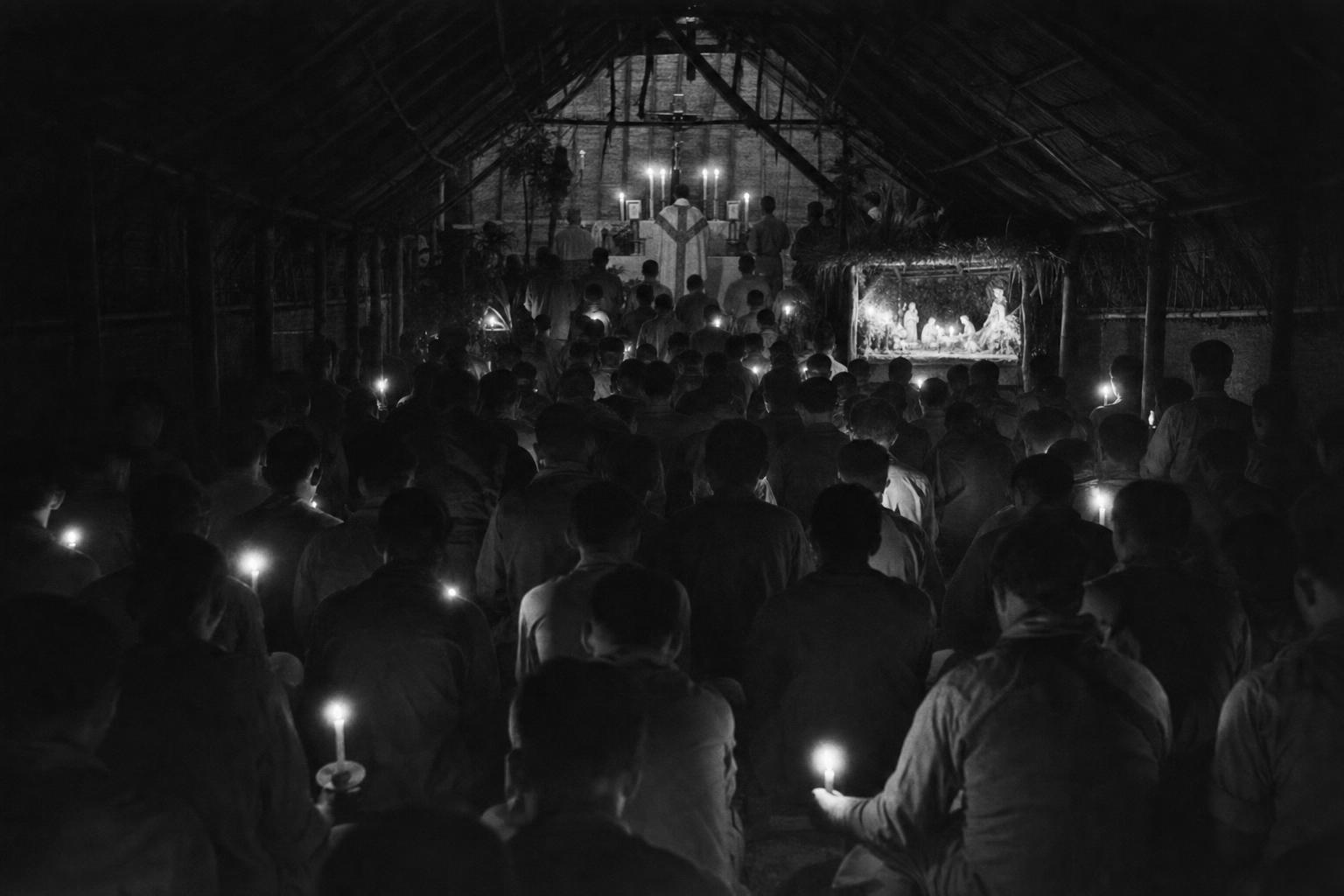
Of course there are happier memories of both camps - reunion with our friends whom we had not seen since 1941, Christy's uncomplicated birth, and the goodness of the Filipino doctor and his wife who gave me cotton wool, a packet of sanitary towels, baby powder and boracic lotion, all things which disappeared from our life 2 years ago. Midnight Mass on Christmas Eve 1944 is an unforgettable memory. It took place in the Chapel Barrack in the Holy City, so called because in 1944 the Japs brought in all the Missionaries of every denomination and put them all together in two large barracks. That Christmas Eve nearly all the internees attended the Mass, the Chapel was full, with people sitting on the Altar steps, in the aisles and doorways. The Dutch Priests had made a magnificent crib out of mud, all the figures so life-like, and painted attractively. The Nuns and Priests sang magnificently and as the bell rang for the Consecration, in the silence one felt an overwhelming supplication from all the congregation, a plea for peace and release from our desperate plight.
My diary records that Christmas Day was happy. Ren cut a bit off a flowering cabbage tree and I painted it with lime scrounged from the toilet cleaners, and a man we hardly knew gave us some tree decorations and three threepenny bits for the boy's stockings! Paddy and Steve had made paper chains and little lanterns and I made a little Father Christmas from some old red cloth. There was a Camp Party too, with a real Xmas tree and Father Christmas in his red robes and long beard (the outfit brought in by the Missionaries in their baggage) and every child ten years and under was given a small present made in the camp, and a calamansi, which is a tiny citrus fruit and a banana. Such a surprise! Paddy was too speechless with joy to thank Father Christmas and wondered how he'd got into camp, and would the Japs take away his reindeer? After tea we went to Benediction and listened to Carols sung by the Priests' and Nuns' choirs, and visited the crib which the children loved, then home and a rush to get the three children into bed before 7.00pm. Can you imagine how we manage every night with only a dim light in the main corridor? My diary says that we thought of home so much that day and prayed that next Christmas we would all be together back in England.
On December 26th, I note that our astronomer friend Nicholas came to lunch and we all shared a can of our precious spam, beans from our plot, and I made a pudding with our daily ration of corn-mush, adding to it a mashed banana and some of the half-cup of sugar Nicholas brought as a Christmas gift. He taught celestial navigation to a small group but the Japs caught up with him, and forbade him to teach navigation so he changed the name of the class to "Astronomy" and continued as before!!!!
More memories - a Christmas present came from old Mrs. Shappie, an English woman in her late seventies who brought me an unopened can of Quaker Oats for Chris, as she said a young life was more important than her old one! Happily she was a survivor, and she and her husband were repatriated to England and later they returned to their home in Mindanao. There was as much charity as thieving in the camp; strangers gave me maternity dresses when I arrived there in a pair of baggy man's pants and an equally shapeless shirt, baby clothes appeared miraculously, and even a beautiful new Shetland Shawl which slipped through the proverbial wedding ring; this I had to return hastily in late 1944, when the donor who had chided me for being pregnant at such an unsuitable time, herself gave birth to a boy in early 1945!! Kindness, and laughter both blossomed under the most bizarre circumstances.
In late December 1944, I summed up our position - "We have no more soap in camp, we have 20 cans of corned beef left which we use at the rate of one every other day to supplement our daily ration of two cups of corn mush for each adult and for which we stand in line for in the morning after roll-call, and again at 5.00pm. The Japs have halved the rations of all children. We are slowly starving to death. Ren weighs 1321bs, I won't weigh myself anymore, Paddy and Steve are losing too, only Chris gains a little, and I am still feeding him."
"He is nearly 16 months old, has twelve teeth (don't I know it!) is very blond, dark eyed and quite firm and chubby. He does have the first indication of Club Foot in both feet due to malnutrition before birth, but the doctors tell me both feet can be completely corrected if I can take him to an orthopaedic specialist before he is three. He walks with them turned slightly inwards and the outside of each foot is curved. I noticed it immediately after his birth."
"In early January the Philippine Y.M.C.A. sent some food to us and it was suggested the thirty-three packets of chocolate should be divided between the eighty children ten years and under, but the Internees Committee decided to put it in the morning corn-mush for 2,150 people!! They hate the sight of children here and will do nothing to help them. In Santo Tomas the policy is "Children First above all Things", but here it is children and pregnant women last. Four out of the six members of the Committee have wives and children at home in America or England so "forget the children, what does it matter if they starve?"
In January 1945, the behaviour of the Commandant and Kunishi became more unpredictable every day - no more open air concerts allowed, we are confined within the barracks, no more visiting other barracks. I seemed obsessed by the number of corn beef cans we still had, sixteen left, one being used every third day to make a vegetable soup. Bowing to the guards one met in the corridors was strictly enforced - of course if one saw one in the distance one turned back. More elderly people were dying, and none of the young men had the strength to try and escape over the barbed-wire fence.
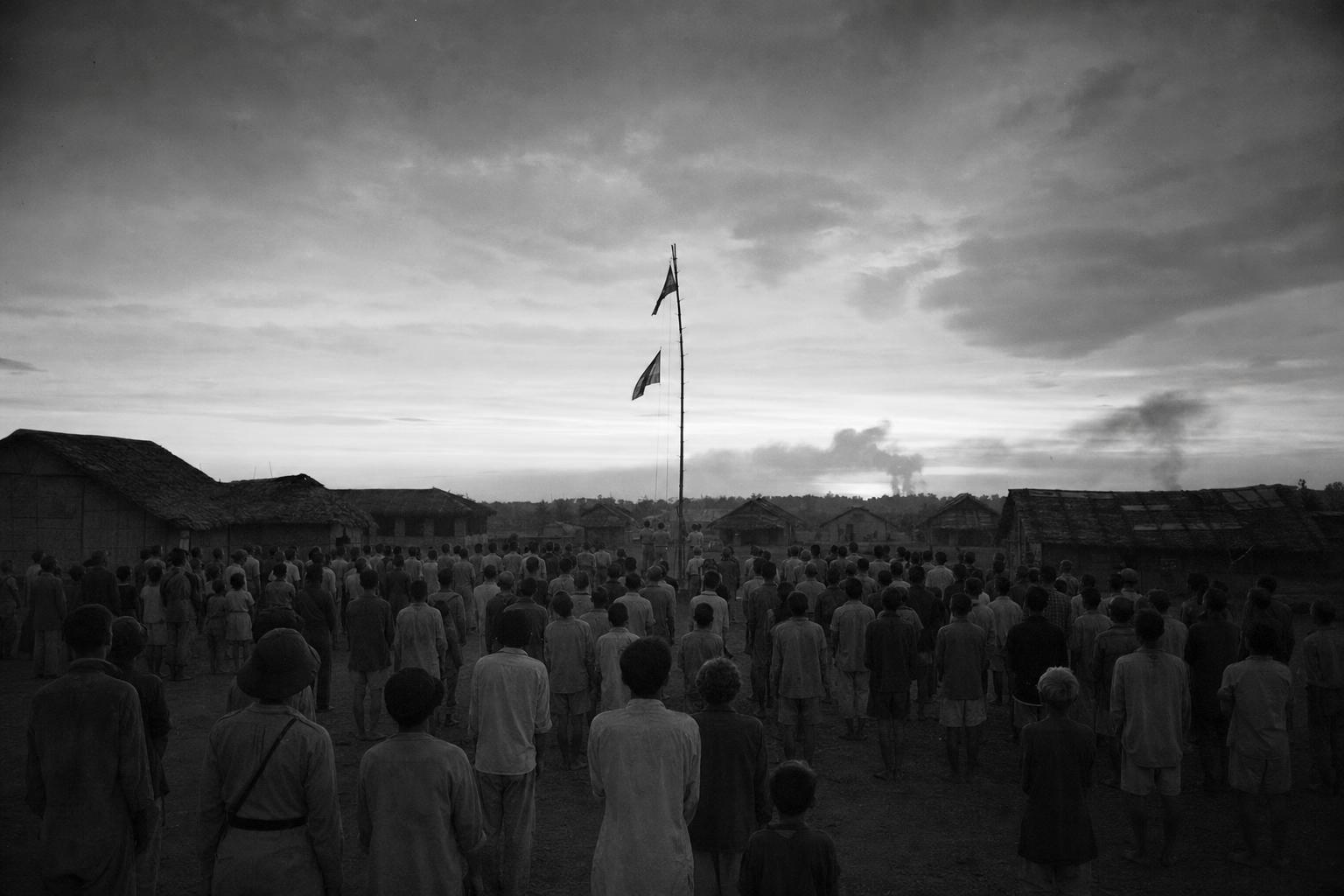
On January 7th the camp was officially turned over to us and all the Japs left. At 5.00am just before dawn, the whole camp assembled and the American and all the Allied flags were flown, prayers were offered for our survival, and release. It was an extraordinary situation to be abandoned behind the Jap lines, starving yet reluctant to venture beyond that fence. We returned to breakfast weak with emotion and fear that we might be wiped out. Already there was a receiving and transmitting radio working, and at last we got bona fide news of landings by the Americans at Lingayen in the north. We simply could not believe that the Japs had gone, and that they had left sufficient corn and rice for 20 days on our present ration. The afternoon of the 7th Filipino came to the camp gate and credit arrangements were made to supply us with eggs, meat and fruit instead of selling it to the Japs in the area. The lights were on again until 10.30pm, no more roll-calls, and the second day of our freedom the pigs left in the Jap compound were slaughtered and we ate them for supper!! For most of the internees it was exactly three years to the day they had been rounded up from their homes and herded into Santo Tomas University, not quite one and a half years in Camp for us, but over three years since we fled to the islands.
We heard the news direct from San Francisco, and were filled with hope, and thoughts of home at last became bearable and we dared to think of being in England soon, and hoped we would not be sent to Australia or Canada temporarily.
Menus were posted daily all over the camp - Mush and ripe papaya and coffee for breakfast, fish, soup and fruit for lunch, camotes (sweet potatoes) beef and curry sauce for dinner. We wondered how there could still be cattle in the district after years of confiscation of livestock by the Japs. They must have been hidden in the hills.
On January 8th after these few days of blissful euphoria, twenty Japs returned to the camp in the middle of the night. They said they had returned to protect us, they did not interfere with us nor did they stop the daily food supplies coming from outside. They issued five kilos of rice to each internee to be cooked by them and a daily ration of one egg per person. Roll-call was not resumed.
On January 12th the landing at Lingayen was confirmed, and all day there was continued gun-fire and the sound of bombs dropping close to us, and our barracks shook which upset the children who knew about earthquakes. The food continued to be good, everyone gained a little weight. Neither Ren nor I could eat the full ration because we developed headaches and diarrhoea but Paddy, Steve and Chris had no problems. Another issue of five kilos of rice was made per person and we were ordered not to eat it but keep it for an emergency. We think the Filipinos around us will soon take to the hills as the Japs retreat, because all day long we can hear firing and heavy trucks moving. The little barrios around us are deserted.
January 13th 1945 I wrote in the diary "We were awakened at midnight by the loud-speakers announcing that the Commandant, Kunishi and his staff had returned! We were told to stay indoors and if it was essential to go out on work duty, to keep away from the sentry-points. They have sealed up all the remaining food stocks in one warehouse and demand an account of all food consumed while they were away. Roll-call will be taken at noon. The Japs are in an ugly mood. No breakfast or lunch from the food line today.
January 14th. One week after our freedom, we are back as before! Kunishi is in charge again and has stopped all trading at the gate. Anyone trying to escape will be shot. We were lined up outside for two hours in the noon sun while guards searched for anything useful for the Japanese compound! Most of them are drunk all the time, the Commandant is a weak-kneed little rat and it is Kunishi who threatens us - I wish someone would kill him.
January 16th. There was practically a rebellion by the internees today. Our Committee went to the Commandant and demanded complete control of all food supplies, trading at the gate again, and parcels from friends to be left there, and removal of all guards inside our barracks! One thing I've always hated and feared, is going along the dark corridor to the latrines and turning a corner to be met by a guard with a fixed bayonet - frightening - though I must add some of them are kind and leave bananas outside the cubicles where they know there are small children, I expect they miss their own families and country as much as I do. All of these requests were granted and a signed statement given to our Committee that the Commandant granted them. So food will come in once more, but I do not trust the b...s.
January 18th, 1945. Two days ago the Jap guards shot and killed one of our men trying to escape - they warned us it would happen if anyone tried to escape. He had a wife and fourteen year old son in America. So far four men have escaped - once past the guards. The Filipinos say there are no Japanese and they have left Los Banos town. The shooting has scared the vendors away, and only milk came in today. I ground some of our rice and made hot cakes using sour dough to raise them. Chris is cross and fretful because his teeth are sore and so are my breasts. When the Japs left the camp some of the wilder men looted their barracks and took away personal stuff and now the Commandant has published a list of articles to be returned including a radio which he wants back by 3.00pm tomorrow or the military will deal with the matter. Our committee begs those concerned to return the loot; some has been returned already including a radio made up of spare parts taken from other radios in the Jap compound. There were quite a few which didn't work any longer.
Foodstuffs continued to come in and the children gained weight. They each get one pint of milk a day and are a much better colour and have a little more energy. Life is nerve-wracking as the Japs are touchy and are being tough because they have lost face by returning and they are drunk most of the time. All the firewood has been used up and today we surreptitiously prised up some floor boards from under our bed. The Japs have refused to let a party go out for wood, nor will they allow Filipinos to bring any into the camp. I wonder how long once I'm out of here it will take before I stop thinking of food all the time?
January 26th, 1945. Manila is said to be surrounded by American Troops and the Japs to be retreating and to be close to Laguna de Bay, the lake Los Banos is on. Old Mr. Kahn bought us a bar of soap today. We cook his rice and coffee for him as he is alone, he is deaf too. He owns the Estrella de Norte jewellery shop in the Escolta in Manila. No more food is allowed to come into the camp and we have only four cans of meat left and I know that very soon I shall have to swap my beautiful jade and diamond engagement ring for one kilo of rice.
Chris hates his playpen in which he spends most of the day but I must keep him in it or I should be pulling him out of the drainage ditch outside our barracks all day. Steve falls in often enough and so Chris would too, and I really have no energy to cope.
January 29th, 1945. No electric light allowed anymore so we all get up at 6.45am in the dark for roll-call at 7.00am and at night it's dark before we get back to our barracks after the call. The Japanese are in complete control again despite their signed agreement. There is absolutely no activity outside the camp, no planes overhead, no noise of tanks or vehicles on the road outside. Deaths from beriberi are increasing daily. It is a dreadful sight to see skeletons walking around with swollen feet and legs. Ren's are swollen and he looks so ill. Another young man has been shot trying to escape, he was left on the ground wounded and later executed.
February 2nd,1945. Kunishi announced today that because of lack of money our rations are to be cut from eleven bags of rice daily to seven bags and two bags of corn to be cut to one. There are 2,147 internees to be fed, and no meat, coffee, molasses or salt will be supplied anymore. No electricity is allowed except in the kitchens where the internees start work at 2.00am, and the drinking-water pumps are only to be operated twice a day. We have begun to collect the daily rain-water in cans. Another internee has escaped.
Feb 9th 1945: Our Committee has approached the Commandant repeatedly about the food situation, and at last he granted an audience. We get exactly six ounces of food a day. He says we are in the centre of hostilities and he will know in three days whether there will be any more supplies, and that if he is still in charge by the 19th Feb. more supplies will arrive. There does appear to be a lot of activity outside again and all week we have heard firing, explosions and movement of vehicles. Today it seems to be literally outside the gates and we think the Japs are at last retreating. Just beyond our barracks behind their barbed wire enclosure the guards have big fires burning, onto which they appear to be throwing camp equipment. There is a large fire burning towards the town of Los Banos near the lake.
Ash Wednesday, February 14th, 1945. We are getting four ounces of food a day and there is no sign of a break in this monotonous life. Everyone is too weak to move around and we all sit about restlessly, even the children have no desire to play. We do know that Manila has fallen and Santo Tomas has been relieved after three days without food and water, and there are many cases of shellshock. A Filipino guerrilla, who got into camp a few nights ago, has taken a message to Manila saying we are starving.
February 19th, 1945. More jottings from my diary: "We were given breakfast today but nothing has been issued for tomorrow. It is rumoured that the Americans have taken Calamba Airfield, about five miles from here. It may be true as their planes are overhead all the time and appear to be taking off from nearby. So far the children are all right but Ren and I are getting weaker and I pray the children will die before we do. It is as much as we can manage to do the necessary cooking and Ren to do our bits of washing. I don't know what would happen to us if Ren didn't stand in line for our food. I cannot even sweep the floor anymore as the broom is too heavy in my hands, and I cannot walk very far - to reach the latrines down the corridor requires a tremendous effort. How we pray the Americans will get here before it is too late. There are deaths every day now. People look so grey and sick an there are always a few picking around the garbage cans for a bit of peel, or hovering near the Jap kitchens hoping they will throw some food over the fence. A nasty sight!! We opened our last can of meat today and I made soup for us all for four days. Thank God for our little vegetable plot. Ren and I just eat vegetables at noon now and the children have a little from the store of uncooked rice we still have. Some people are eating fried Canna leaves.
February 22nd, 1945. A terrible day. There is no food in the camp and the Japs have issued a ration of palay, (unhusked rice) to each person, which we must husk and winnow by hand, the end result just 50% of the original amount. It took us all day pounding the rice with a bottle, and when we had finished there was barely enough for one meal. Ren has put it under the bed to cook tomorrow after roll call. We are in despair and I have decided to take my ring tomorrow to that terrible American/Italian who barters rice for valuables. He deals with the Japs - food for jewellery. Ren went along to his cubicle to say he will bring the ring tomorrow and collect one kilo of rice for it.