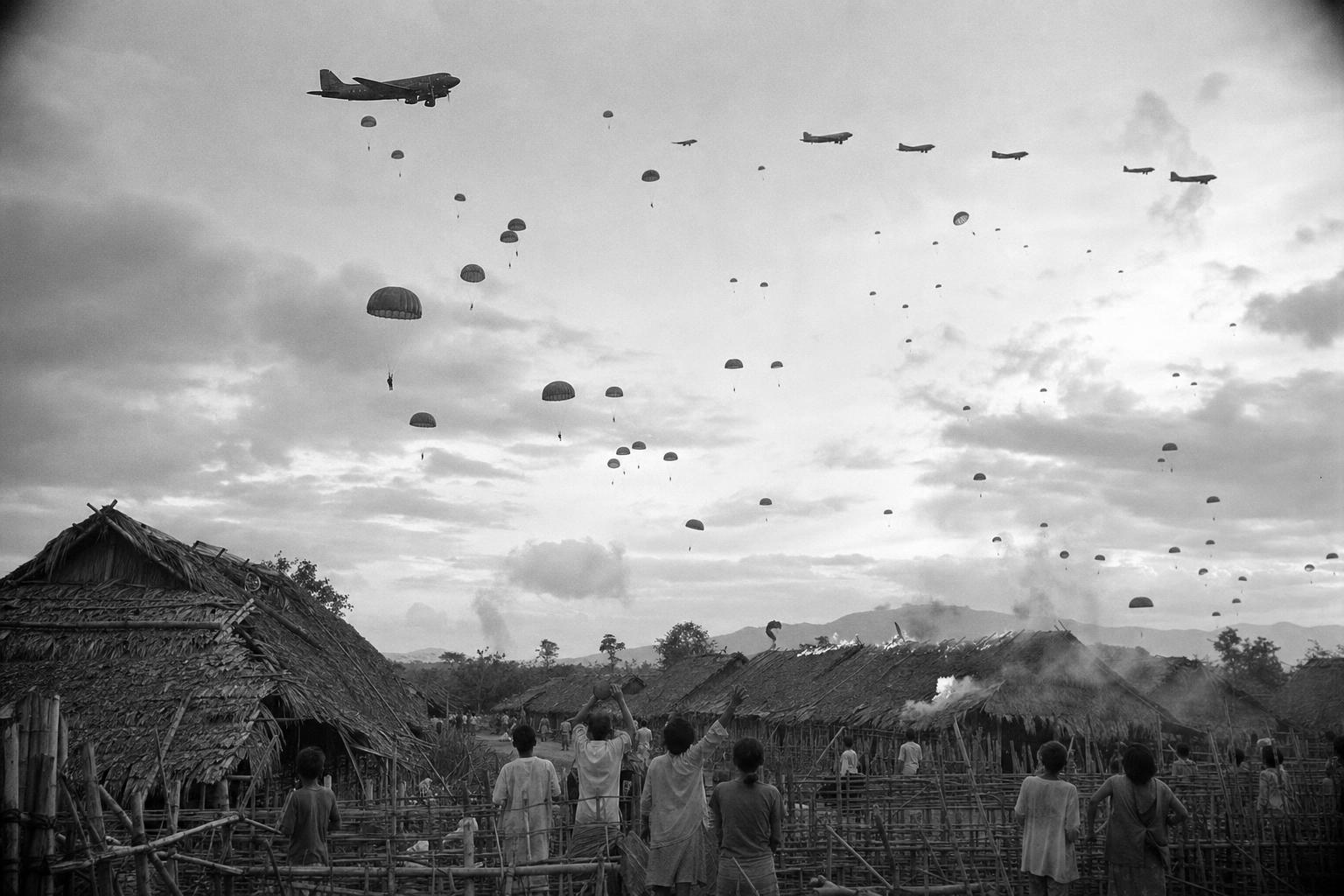
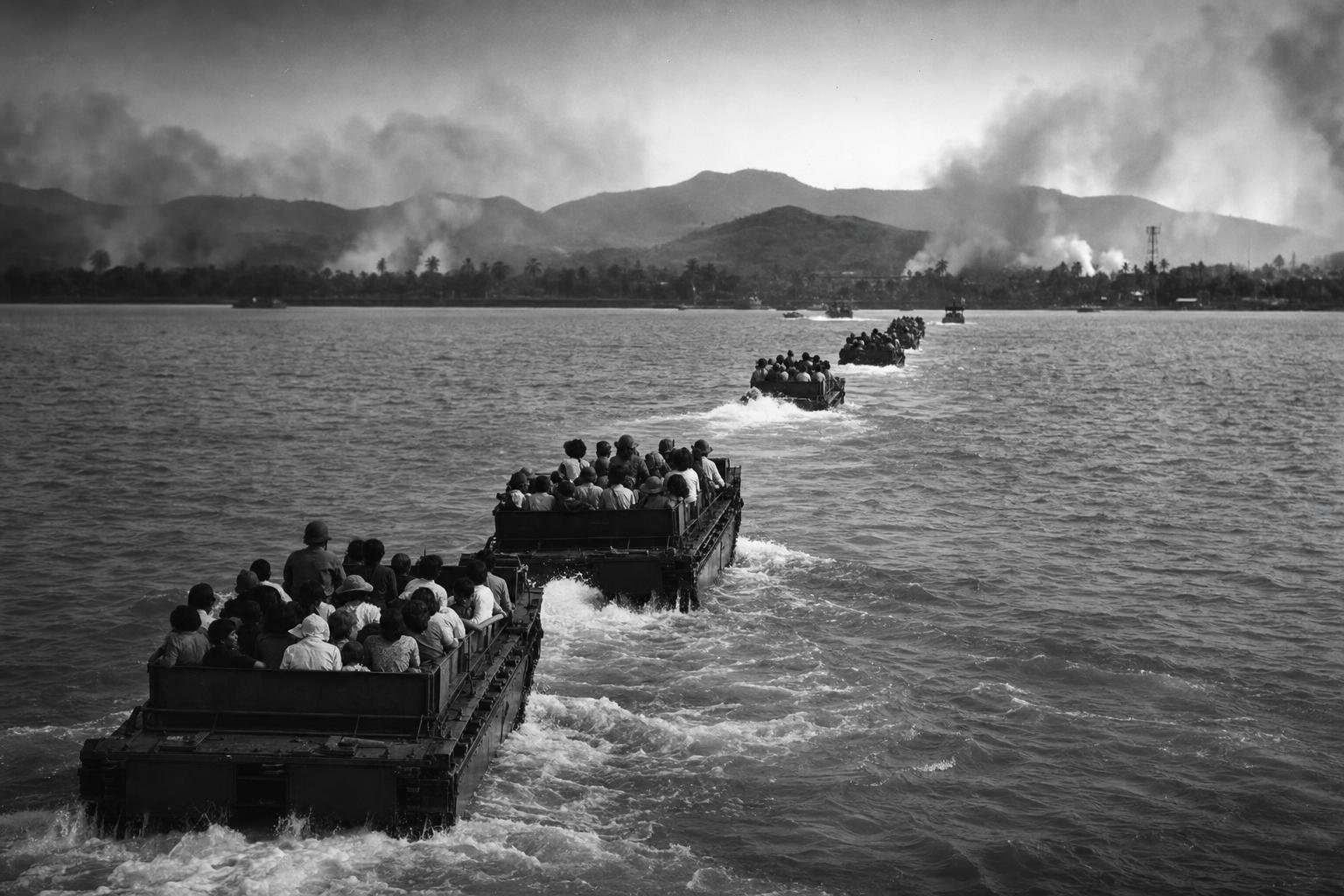
FRIDAY FEBRUARY 23rd - LIBERATION DAY - Never to be forgotten as long as I live!! We got up at 6.45am as usual after a very restless night, during which we had heard very heavy truck movements along the main road and hoped they were Japs retreating. Looking out of our window we were astounded to see American planes all around us, some with the word "RESCUE" on them, and five minutes before roll-call were even more astonished to see parachutes dropping from these planes, and the sound of gunfire inside the camp. We went back into the cubicle and Ren put the mattress against the window and we all lay as flat as we could as far under the bed as we could get. News drifted across the cubicles that the Japs had intended shooting us all at roll-call and units from several American Divisions had arrived to rescue us. Planes droned over us, bullets were whizzing about and had set the nipa roof on fire. Just as suddenly as it had begun the firing stopped, and Filipino Guerrillas and American soldiers strode down the corridor telling us to collect a change of clothes and go to the camp gates as fast as we could go. Simultaneously we both thought of our hard earned rice ration cooking on the verandah, and that my engagement ring was safely on my finger where it had been all night as I thought, for the last time. By now, most of the barracks were on fire as all the internees hurried down to the gates. As I went along with Chris hanging on to me I saw one of the Jap guards dive down a big drain pipe, and an American soldier throw a hand-grenade after him. At the gates fifty-nine Amtracs were lined up into which we were herded and we started off down the deserted road to the lake. I saw another of our erst-while guards mown down by the tractor in front of us. In convoy, we started the seven and a half mile journey across the lake which was still in enemy-occupied country. Jap snipers fired on us from nests in the surrounding hills and we got nine bullet holes in our tank before they were silenced by American planes. One Amtrac was sunk but everyone was rescued by the following tank. There must have been about twenty internees to a tank, and four soldiers who manned two fifty calibre machine guns. When we arrived at Mamatid Beach, women and children were loaded into heavy army trucks, bolted in and told to hang on, that there would be no stopping until we were through enemy territory. It was a terrifying ride made much worse because the back-flap of the truck dropped and several passengers had to hang onto a woman who had nearly fallen out of the truck. None of the children in the truck showed any sign of terror, perhaps because they were already benumbed by the day's happenings. Once out of enemy territory the driver stopped, bolted on the flap once more, we all relaxed a little and off we went again.
On arrival at Muntinlupa Prison, we were given chocolate, cigarettes and blankets and taken to a soup kitchen, after which we were shown somewhere to sleep temporarily. Paddy and Steve were so thrilled to see real soldiers, who were so kind and so jolly with them. They soon fell asleep but Chris was too exhausted to do anything but cry fretfully. I sat on a bunk with him while Paddy and Steve slept and I prayed that Ren would arrive here safely. I imagined counter attacks by the Japanese at Mamatid Beach while the rest of the internees awaited the return of the trucks, and the arrival from across the lake of the last load of internees and soldiers from Los Banos. He got here by 4.00pm and both of us were overjoyed to be all together again.
The Rescue Operation by the Units of the 11 th Airborne, the 571st Parachute Infantry, Nine C-47 Aeroplanes of the 65th Troop Carrier Squadron, the Reconnaissance Platoon group and Filipino guerrillas was an incredible feat. The camp was fifty miles behind the enemy lines, and at that time between eight and fifteen thousand Jap troops were within four hours march of it, and yet the rescue was so planned that the team arrived at the precise time of 6.45am to prevent the internees being slain at roll-call; they exterminated all the Japanese guards and got the 2,147 internees across Laguna de Bay without loss of life. In the operation 247 Japanese were killed, some before the actual attack by the Reconnaissance platoon and Filipino guerrillas, two American soldiers were killed and one internee slightly injured. General of the Army, Douglas MacArthur is said to have radioed to the Division Headquarters "An Operation such as that performed today will gladden the hearts of soldiers throughout the world." For once he was right!!
After we were safely evacuated, the troops all returned across the lake with the last lot of internees.
Muntinlupa was used as a Base Hospital for the American Army and for civilians who had come under fire as the Japanese retreated. As well as surgical cases there were many young soldiers suffering from Battle Fatigue, which really meant they were having terrible nervous break-downs. It was heartbreaking to talk to them so lost and far from home, many of them only eighteen years old. We were encouraged to talk to them and help distract them, and I do think the young children did quite a lot to help them forget about the war for a little while.
We internees slept in the long prison dormitories in two tiered bunks. I had Chris with me and Ren, Paddy and Steve slept on one of the men's floors. Memories are a bit of a jumble, because my diary which I had kept so conscientiously for so long came to an abrupt end. I was ill for a week with dysentery and was put in a tent in the hospital compound and my camp-bed was beside that of a little Filipino girl who was nine years old. She had been bayoneted repeatedly as the Japanese retreated through the villages or barrios. She was brave and cheerful and thought she was one of the lucky ones because she still had a mother alive and unharmed with her in the hospital. While I was sick, I at last weaned Chris who was left with Ren, and I was so pleased to be given three new bras, and to be outfitted with regulation army shirts, slacks, shoes etc. When I was transferred from the tent into the prison hospital, and slept in a ward with only four others, I remember what bliss it was to feel I didn't have to do anything but doze the day away so peacefully!
The last entry in my diary comments on how wonderful the food was a day and children from 1 year old to 6 years had milk and cookies at 9.00am and more cookies and fruit juice at 2.00pm. Our children grew visibly day by day and Paddy and Steve had a wonderful time being talked to and made much of by the soldiers and convalescents who lifted them up on their shoulders and took them walk-about.
The prison was still just on the edge of enemy territory and small numbers of Japanese hiding in the long cogan grass attacked the camp sporadically the first few days after our arrival. Hidden just below ground and camouflaged were four fifty calibre machines mounted on a tracked vehicle. They were sited just inside the camp perimeter and the soldiers manning them set the cogan grass on fire with tracer bullets, and there were no more attacks on the camp because there was no more ground cover to hide the Japanese. Life was fantastically interesting; there were so many things we'd never seen before, walkie-talkies, land-rovers, bulldozers, tracer-bullets and helicopters landing on the flat roof of the prison, all things developed during the war.
A few days after our arrival in Muntinlupa, Pete Grimm, head of Luzon Stevedoring and now with the Army came to see Ren to tell him his Aunt Nati and Uncle Hubert had been massacred by the retreating Japanese in their Vita Cruz home with many of their Spanish friends, most of them women and young girls. The retreating Japanese went into every other house in the streets they passed through and massacred every occupant and destroyed the house by setting it afire. Hubert had been allowed to stay out of Santo Tomas because he was seventy five and crippled with Rheumatism and he was married to a Spaniard, and all his family was in England. His wife Nati had spent the war years working for the Red Cross, caring for the sick and the destitute, driving miles daily in a caramata, which is a small horse-drawn cart, to bring them what food and medicines were available. I did not know until our return to the Philippines in 1946 that she and Hubert had paid for my stay in the Mary Chiles Hospital when Chris was born. In that year too, Ren received from President Quirino the Red Cross Gold Medal, which was awarded to her posthumously; and which he sent to his cousins in England. Pete Grimm also told Ren that Fathers Kelly and Monahan had been crucified in Malate Church before the Alter where we had been married and where Father Kelly had Christened Paddy in 1939. Our Irish friend Jack Sullivan, who lived with these Priests was killed in the Church with them. Jack walked across Manila the day Chris was born to bring me an orchid. Pete Grimm took Ren into Manila in his land-rover to see what remained of the Vita Cruz house, and when he got back he told me the devastation was appalling, whole districts had disappeared and the stench of death under ruined buildings was overwhelming wherever they drove. In the walled city, the Catholic Cathedral with it's huge Statues in the forecourt, the Archbishop's Magnificent Palace, the old University and St Joseph's Hospice, all built in the time of the Spanish Occupation, were rubble. The Japanese had made their last stand behind the walls and the Americans had to dynamite through them so nothing was left of this ancient barricade. Pete told him that when the Americans were advancing, the Japanese massacred 60,000 people in the city in three days. Occupants of houses were forced to stay inside while they were burned to the ground; hundreds of people of all nationality were herded into Churches, petrol thrown into the building and it was set alight, and anyone trying to escape was shot. In this holocaust the Japanese killed their own Allies, no one was spared. In the German Club the members were thrust into the air-raid shelter, petrol poured in and they were burned to death. Others died in Rizal Stadium where they were taken in so-called "work parties" and shot, and in the Philippine General Hospital the Japanese soldiers ran from bed to bed bayoneting helpless patients. One friend escaped by hiding herself in a bathroom cupboard. Just the shell of the Perez Rubio house where Nati and Hubert had lived remained, with the wide marble steps leading up to the verandah intact. We were married from this beautiful house so happy memories will always vie with tragic ones. When I arrived by ship in Manila in 1937 at 7.30am there was already a heat haze hanging over the sea-wall and the boulevard along which we drove to Vita Cruz. The flame trees and Jacarandas were in bloom, the former a flamboyant red amongst the shining palms, and amahs played with small children on the sandy path. The white paint work and the brass gleamed and twinkled on the boats anchored in the yacht basin, our "Vixen" amongst them, but now in March 1945 it was a desolate place, no trees, no benches and the people had fled.
We celebrated Easter Mass in the Prison Chapel. Such a contrast to Mass on Christmas Eve in Los Banos! The Chapel was very plain with white-washed walls deeply recessed windows and two heavy wooden doors opened wide, through which the sunlight flooded turning the walls to pale yellow. There was no despair at this Mass only a feeling of Thanksgiving, joy, hope and gaiety. We waited through March hoping each day to hear when we would start our voyage home. A Hospital ship and several planes had already gone to the States. We were given the usual injections and sufficient warm army clothes for the voyage to England via the States, and told to be packed and ready to leave at short notice. Early in April we climbed once again into huge army trucks and with 4,995 other internees we were driven to Manila's North Harbour to embark on the American Troopship U.S.S. EBERLE bound for the port of San Pedro, Los Angeles. We drove through miles and miles of rubble and the shells of burnt out houses, through a wilderness where there had been beautiful houses and Magnificent Civic buildings. This and the smell of decay and the thousands of flies buzzing everywhere was something I never wanted to experience again.
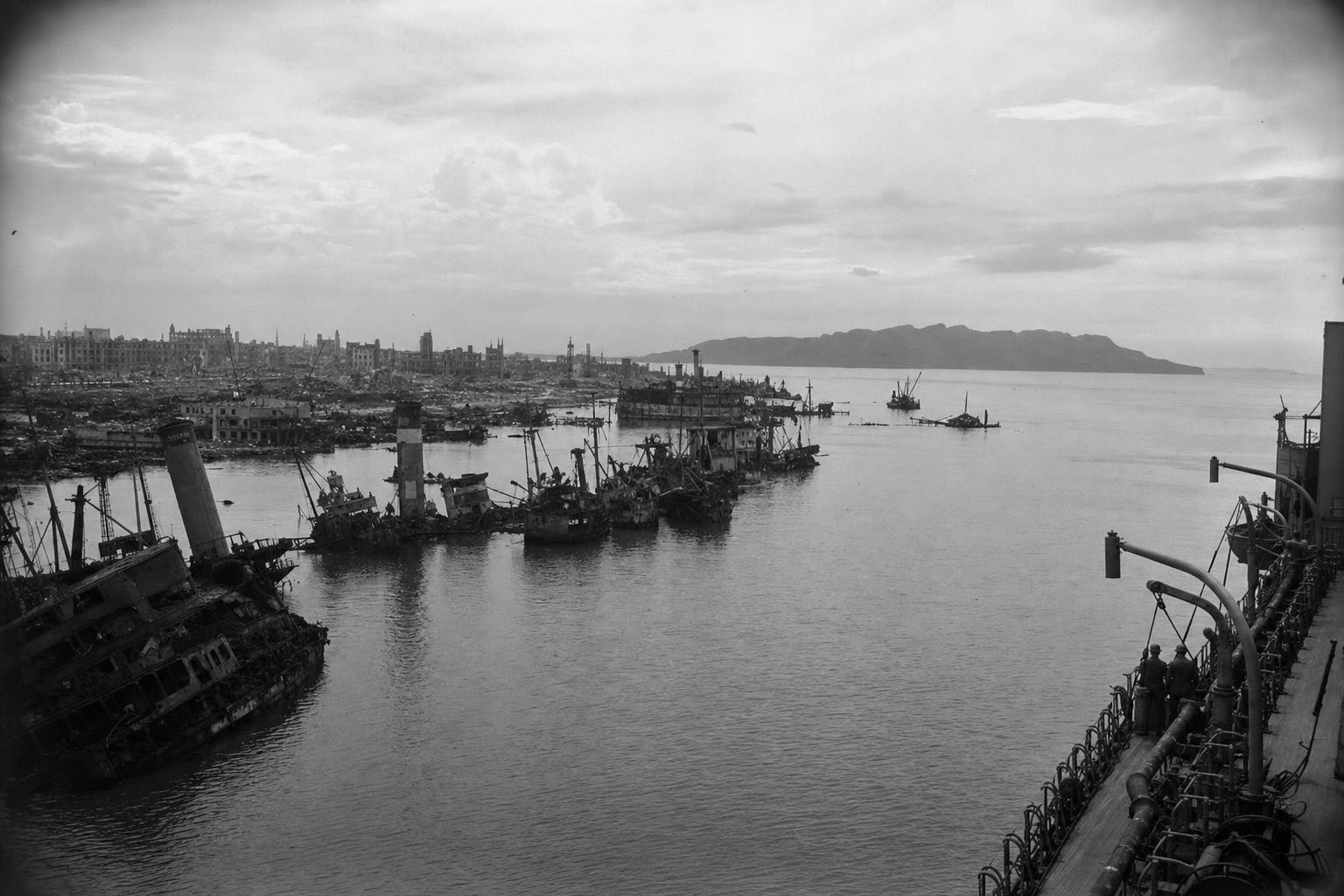
There were no piers left in the harbour, so it was a slow business to ferry us out to the ship in amphibious tractors. At last the ship began to thread her way slowly past dozens of wrecks, some half sunk, others almost standing on end, and many with just the tips of masts showing above the water. As we neared Corregidor Island where the Filipino and American soldiers had fought such a brave and hopeless fight, I remembered how used we were to sailing down the Bay at sunset in the "VIXEN", scudding along to Lilimboan Cove which we reached about Midnight. Poor little "VIXEN", now sunk at the bottom of Legaspi Harbour. I wondered whether we'd ever have another Vixen, would we return and rebuild lovely old San Roque, would we visit our island friends who had taken us in when we were homeless?
Uppermost in my heart was that at last we were on our way home!!!
1