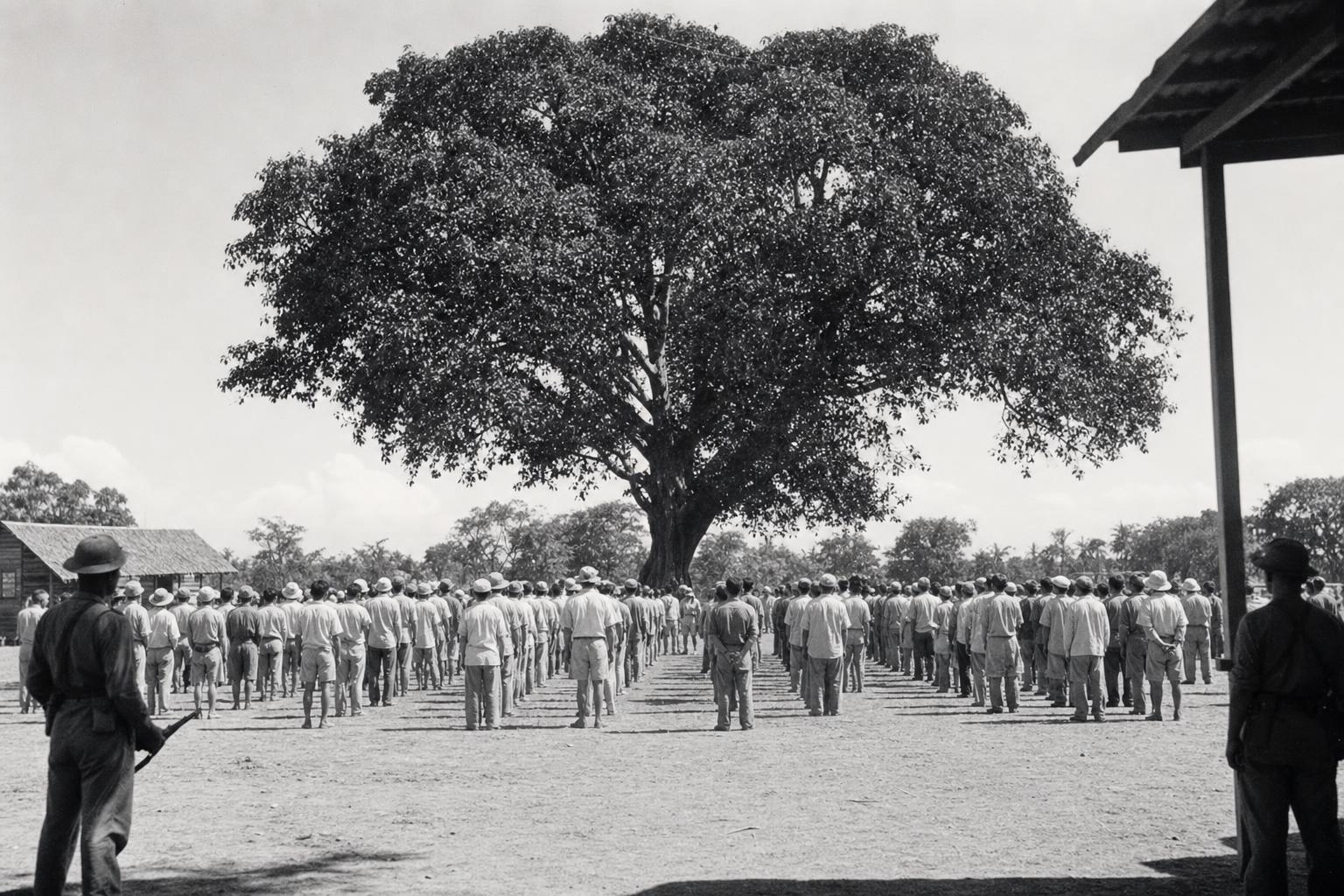
Throughout internment there was a hidden radio in the camp and the Los Banos one was never discovered despite repeated searches by our guards. They would line us all up in the hot sun for hours while they ransacked our barracks, the kitchen, the hospital. Once our little family stood directly under a tree in which we could see a thin aerial in the branches which the radio men had forgotten to pull down, and we waited for a child to ask "Daddy, what's that wire in the tree for?" It was incredible that however much one tried to keep ones eyes on the ground, they went back up to a particular branch! It was not discovered, and thankful we all were to return to our barracks unharmed. Most of the internees knew there were hidden radios in Santo Tomas and Los Banos, but never spoke of them, and war news filtered quietly through the camp, particularly if it was good. We were awakened for roll call each morning by a loud speaker playing a popular tune and when the Americans were getting nearer to Luzon the tune would be "Little Man You've Had a Busy Day" or we'd be admonished to "Get up Smartly, better Leyte than Never"!!!
We settled down in our barracks. The children were happy and normal and continued to grow although they were very thin, indeed Chris was the one who looked healthy and quite fat as I fed him myself, and Doctor Nance at the Hospital arranged for me to get a bowl of rice gruel for him each day. Epidemics raged through the Camp, whooping cough, measles, mumps, influenza. Both Paddy and Steve had measles and Paddy developed pneumonia and was put in the men's ward in our small hospital because the children's was full, and he was spoilt by both the men and nurses and was soon better despite the lack of medicines.
We grew vegetables in our little patch - papayas, green beans and corn, and enjoyed cooking these outside on a wood fire in an old tin can. On one occasion we actually cooked a chicken which flew over from the Jap barracks into our plot. Ren picked it up and took it squawking into our cubicle where he hid it in a bucket upside down under our bed. We consulted our monitor John King and he advised us to wait and see if the Japs made a fuss, then we'd have to let it loose, and if they didn't we should cook it. I quote from my diary "Yesterday we had chicken for dinner." No enquiries were made by the Japs so Ren swiped its head off with a bolo, and I shut my eyes and held its wings and feet. I plucked and cleaned it in our bedroom while Ren kept watch outside, and later we buried all the evidence in a hole outside. Ren fried it with Okra, garlic and beans. Paddy, Stephen and Chris had a wonderful time, particularly Paddy who sucked and chewed until I thought the bones would disappear too. We gave some to three small children next door so altogether one little Japanese chicken has given intense pleasure to eight people. After the bones were well sucked, I collected the bigger ones and boiled them for Chris to teethe on. All I hope is another chicken flies over the barrack wall.
Thieving abounded; it was impossible to leave clothes outside a shower, and soap disappeared if one turned aside from a sink for a few seconds. Papayas and vegetables were stolen from allotments, and many lucky enough to own a papaya tree, hung cans with loose stones inside and anyone pulling a branch down to pick a ripe papaya ran off quickly when the can clattered.
Thieves were everywhere and clothing left unattended on wash lines or in the showers disappeared in an instant. Everyone's clothing was threadbare and faded and dresses and shirts often backless where sun and perspiration had worn them away. Paddy, Steve and Chris had shirts and shorts given them by friends whose children had grown out of them in the first year of internment, in fact we depended entirely on clothes given us by friends. A Spanish friend sent an iron cot into camp for Chris which was wonderful because it was the only bed we had which bed bugs didn't crawl over nightly; Paddy and Steve slept in bunks made by Ren in the carpenters shop, and he and I slept on the floor on a mattress given to us by friends. I discovered in Hospital that if I kept the bedside light on no bugs attacked me, but the minute I put it out they swarmed along the mosquito net rails and began biting. In camp I got bitten night after night but for some reason they didn't like Ren's, Paddy's Steve's or Christy's blood, and they were literally immune from them. Putting mattresses out in the sun helped to get rid of some, but they were in all the wood work too, and they became just another nuisance to put up with. The Hospital in Santo Tomas depended on alcohol made in the University Lab for sterilising and the Lab also made chlorinated lime for the long-drop latrines, and caustic soda and soap. To obtain one piece of the latter we stood in line for hours or sat on the ground. Sanitary towels, and cotton wool were unheard of luxuries and each woman was given six cotton squares with her name and dormitory stamped on them. After use these were deposited in a container in the toilets and they were boiled in the hospital laundry and returned to the owners dormitory next day. As we all grew weaker and more harassed, menstruation stopped for most of us, and after Chris was born I didn't start again until late 1945 in England. Nature can be kind and the only snag was that one never knew if one was pregnant or not, but in 1944 there were very few who had the energy or urge to sleep with anyone. I think only two or three births were registered in Los Banos in 1944, born to young people who obviously still followed their natural desires.