Our son Christopher was born on September 9th 1943. He was not born in the camp because the Japanese sent me to a hospital nearby run by a Filipino Doctor. I don't know why they did this, and I would have preferred him to be born in the Camp Hospital with Ren there. As far as I'm aware Chris was the only child born in Santo Tomas in 1943 - perhaps the reasons were because the Japs forbade cohabitation between wives and husbands, punishable by solitary confinement for the father, or perhaps it was the complete lack of privacy, although determined couples always managed to find somewhere to meet be it in the lift halted half-way between floors in the main building or by escaping from the dormitories undetected by the guards who patrolled with bayonets on their guns.
The Filipino Doctor and his wife who ran the hospital, The Mary Chiles Presbyterian Mission Hospital in peace time, were wonderfully kind to me, putting me into a private room with a bathroom ensuite. The Japs let Ren out to visit me the day Chris was born and that same day he went to the Convent to see Paddy and Stephen, and he told Paddy he had a baby brother for his own special birthday present! I stayed in the hospital two weeks, and took every advantage I could to wallow in the bath in complete privacy - there were no doors on our showers in the camp! Nevertheless I longed to be back in Camp with Ren and the children, and was happy when the kind Filipino doctor took me back in his car to the camp gates where I was admitted after spending nearly an hour in the guard-house because I had no pass!!! The boys came back to us when Chris was three weeks old and we soon felt there had always been five of us, not four.
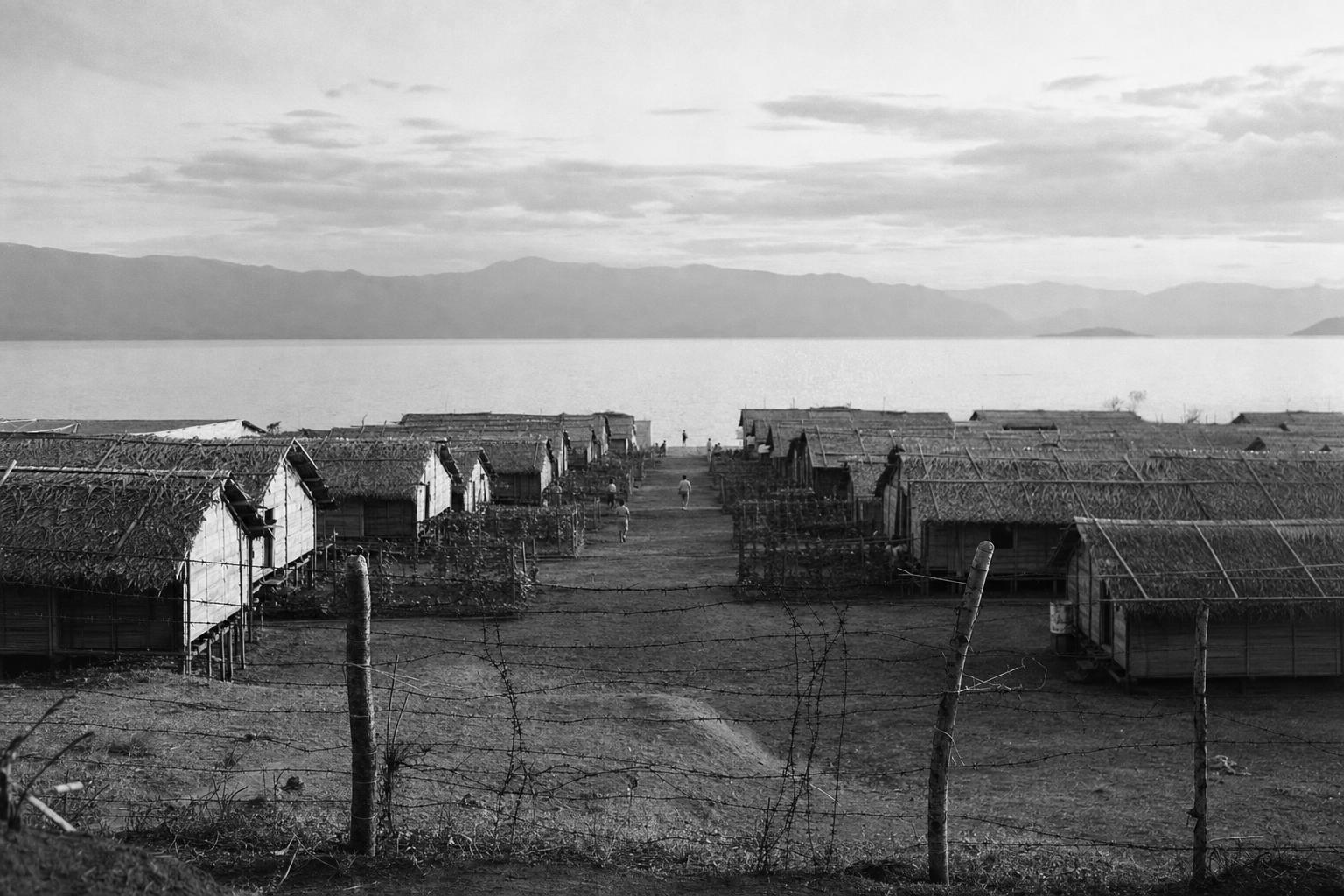
We were in Santo Tomas until Easter 1944, when 2,400 volunteer internees were transferred to Los Banos Camp, formerly an Agricultural College about 40 miles south of Manila on the shores of Laguna de Bay. We decided to volunteer because this camp was in the country, had half the number of internees than Santo Tomas, the quarters were more private, each family having one room in the Nipa barracks, and we felt we'd be safer when the Americans retook Manila which we felt they would do quite soon. Each barracks had a small allotment in front of each room where we could grow vegetables from seeds provided by the Japs and we could cook them on a fire as long as there was wood. Ren did his three hours work a day in the carpentry shed so we usually had wood shavings etc. Life at Los Banos was easier although we got less food as the year progressed. All the camp work, cooking, maintenance, gardening, teaching the children between 5 and 17 years, emptying latrines, looking after the sick was done by the internees, and everyone was expected to behave decently to one's neighbour, to do one's allotted three hour job per day without grumbling and to obey the camp rules which were made by the Committee of Internees. A Committee of Law and Order was set up and a representative from each nation sat on it and sentences were imposed on anyone proven guilty of breaking camp rules.
I served as the British woman representative for about a year. The "crimes" were petty, food stolen from the kitchen, vegetables from neighbour's garden plots, and family quarrels between husbands and wives mostly due to the cramped conditions we lived in. The family quarrels only came to court if there was violence involved. There was a lighter side to the sittings when known prostitutes like Shanghai Lil came before us to claim her Sugar Daddy had not paid her enough corned beef for pleasure received, and he said he'd never promised any such thing!! Another case involved Lil and a fellow prostitute with whom she shared sleeping quarters. They only owned the one bed, a double one, and after a quarrel, Hong Kong Anna had left and gone to live with someone else and had taken the bed with her. Shanghai Lil told the court she needed her half share to keep her alive. I heard more obscene language on that court than ever again anywhere else in the world. The women who were convicted of stealing vegetables while preparing them for our meals had to serve a day or two in jail. I hated being in court on those days because some of them were my friends and I knew they stole only to feed their children and I could easily have committed the same "crime". I was only on the court if the women involved were British.