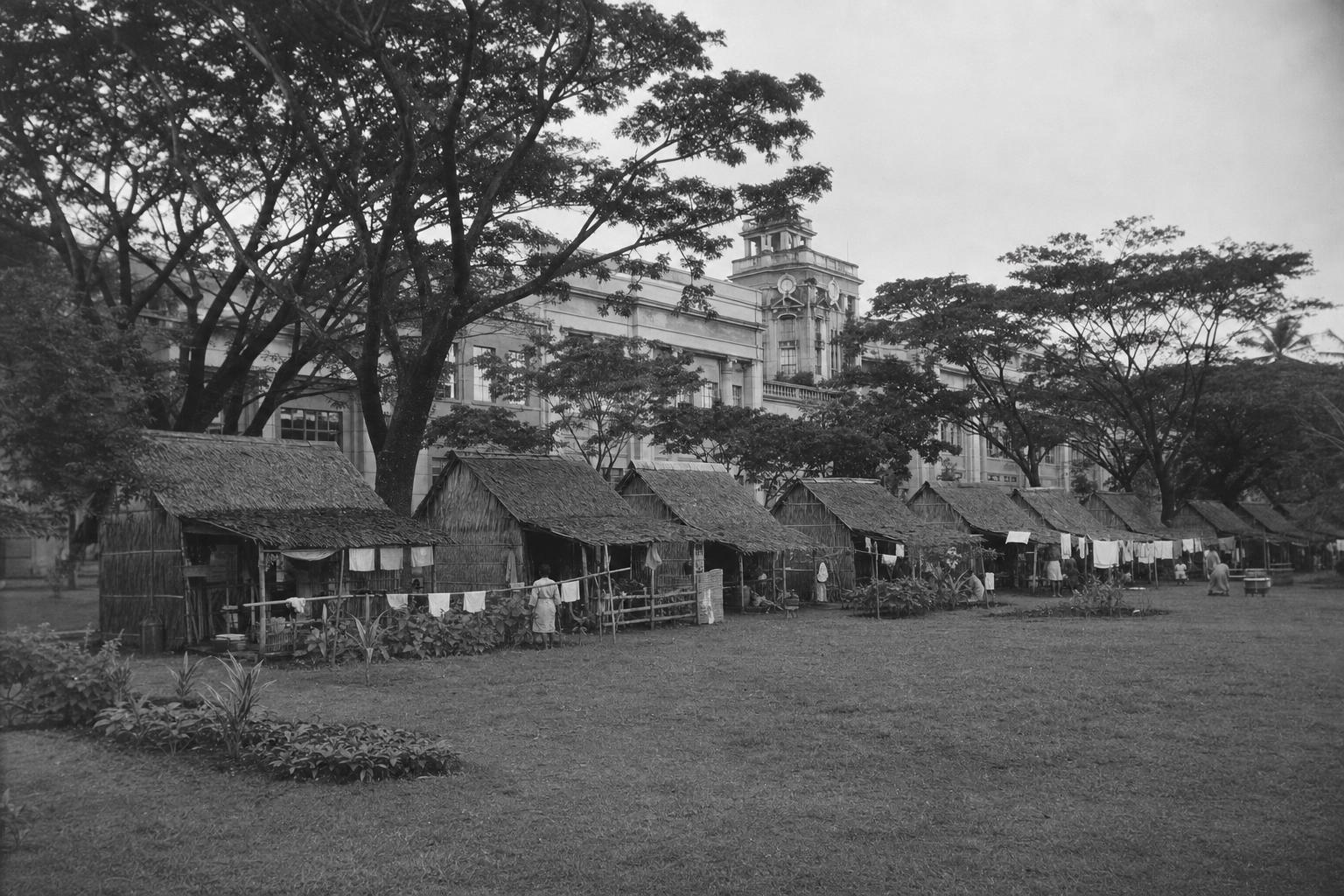
The continual hum of 5,000 people moving about and talking was shattering for the first week, rather like an enormous hive of humming bees. Standing in line for hours for food, showers, loos, wash places was something we had to get used to and we mourned the loss of peace and privacy.
David Cassels Brown was one of the first of our friends to look us up after our arrival. We had heard news of him while we were out on the hills, that he had been imprisoned in Legaspi and later taken to Naga jail with our Albay friends but we did not know that he was in Santo Tomas. We did not recognise him at first because he was so thin and looked so ill. He told us that after we left him in Tabaca he had been taken prisoner and put in an underground garage for 27 days in Legaspi; without a change of clothes or any washing facilities. He was taken out to the main street to urinate and defecate. After 27 days he was taken out to be shot, and for the first time during his imprisonment there was an English speaking captain with his guards and as they put him against the wall, David told him that in a civilised country Consular Representatives of an enemy country were not shot but repatriated. The Captain took him back to the garage. made enquiries and then sent him to Naga jail to join other prisoners from Albay.
The jail was subsequently broken into by Guerrillas, the prisoners freed and he fled to the hills and like us was eventually brought into camp after many adventures. Our Iriga friends, the James family and Katherine and Ralph Rawson were still hiding out in the Caramoan Peninsular. Eventually when the Americans returned they were picked up by submarine and then flown back to the States. I soon learned that if I wanted a peaceful shower, 5.00am was the time to take it. There were no places for the prisoners, or should
I say internees, to sit except outside dormitories, in the dining sheds or under trees unless one was fortunate enough to own a small nipa shack in the grounds. The Japanese allowed internees to build these during the first few months after the occupation, built of nipa and bamboo the internees paid for the material and built them themselves and they had to have the front of the shack open at all times for the Jap guards to look in as they passed. At least they were places where families could spend the day together before we were all separated at 9.00pm. No lights were permitted in them as we used them only from 7.00am to 7.00pm. Between 7.00pm and 9.00pm we were not allowed in them. At first we hated camp life and wished we'd stayed in the hills, but there were compensations - being with close friends again and the sense of unity between us all - British, Free French, Americans and Dutch. There was daily Mass in the beautiful little Chapel on the top floor of the main building, Anglican services in the hall which was part of the University Rector's private suite before the University was taken over by the Japs, and internee doctors and a hospital run by volunteers and trained nurses. There were few drugs available but plenty of tender loving care.
Splendid concerts were held once a week outdoors, sometimes a film with the Commandant and his men sitting in the front row. They understood very little English and it did our hearts good to hear a trio of Dutch Priests singing in English the most scurrilous songs about them while we stomped and cheered.
Each day we stood outside at 7.00am and 7.00pm while the guards counted or recounted us as they made mistakes frequently.
Soon after our arrival Ren became very ill and was isolated in the hospital with a very high fever for about 10 days. I was sure he would die. The doctors did not know what was the matter and eventually the Japs sent a specimen to the Philippine General Hospital and they diagnosed Typhus which had not been known in the Philippine Islands for many years, but the Japanese had bought it back with them, just as they did Malaria. Ren must have picked it up on the troop train coming to Manila, and later on several internees brought to Santo Tomas in the holds of rat infested ships caught it. While he was so very ill - I really did not think he would survive - I could not stand in line for food, do the washing, meagre though it was, look after Paddy and Stephen and I had to reluctantly agree they should go to a Convent near the camp where Nuns looked after the children of internees who were ill or had died in camp. The Japs allowed visits once every two weeks to the convent. It was a sad spectacle seeing single mothers and fathers or an "Aunt" hugging their children, playing with them until the house came to say "goodbye" and then the children were re-assured that we'd all be together again soon. It was too painful to talk to anyone in the bus on our return journey, everyone determined not to be the first to cry. One friend who worked at the convent told me Steve became known as "Little I want a kiss" because that is exactly what he said to every adult he came across.