Like most of the islanders the people here earned their living fishing, stripping Abaca for rope making and drying copra. Some of the houses had hand looms on which the old lola or granny of the house wove abaca for clothing and mosquito nets and fine fishing nets. Mountain rice and corn grew on the hills and sugar cane on the flats. Each hut had its vegetable garden, a few hens, a pig and the man of the house owned a fighting cock which received more consideration than anyone in the family. The men who worked on the copra and abaca plantations were usually better off than the fishermen because they could build a small house on the landowners property and they were well paid for working on the plantations. The islanders were really self supporting, and in the peace time bought small luxuries from the town with money they earned selling fish or eggs or raw sugar in the town markets.
Filipinos are never beautiful unless they have some Chinese or Spanish blood. Tomasa was a typical country woman, small and thin with a dark brown smooth skin. Her long straight hair drawn tightly back from her face and knotted into a firm bun on the top of her head, accentuating her very prominent, high cheek bones. Generally she wore an ankle length tapis twisted around at her waist with a sleeveless cotton camisa on top, her big feet were bare unless she wore wooden bakyas in the mud or embroidered velvet slippers for visiting. She always carried and umbrella as most Filipinos dislike feeling the sun on them. They were always astonished that I never wore a hat or carried an umbrella. Tomasa's eyes were dark and very gentle. As she did not chew betel nut her teeth and gums were not stained red. She wore pretty gold earrings. Filipinos are nearly always clean and wear colourful crisply starched clothes. Jose Barde, our host, was a dried up little man of about sixty. He was prosperous as he owned a coconut plantation, two boats, two fish traps and several cuyog nets. His fishing boats and his big sailing bartel which he used for transporting coconuts and dried fish were kept alongside the house up on the beach. Here there were poles driven into the sand and across them his nets were hung. He wasn't home often as he spent a lot of time fishing, or he was always trading, but like Tomasa had done, he welcomed us in Spanish and begged us to make his house our own.
A big clay bank in front of the house protected it from the wind off shore and coconut palms and huge pili-nut trees sheltered it at the back. From them, a steep track led to a camote and corn patch and to the waterhole which was surrounded by abaca palms, and in the rainy season, clouds of mosquitoes. High up on the camote patch there were no trees and so one could look far out to sea with Catanduanes Island away on the horizon and next to us with narrow passages between a series of small islands including Namoddie, Batan and Guinanayan, and beyond them Rapu Rapu at the mouth of Albay Gulf and out of sight sixteen miles further up the gulf, San Rogue House, our dear home.
Tomasa was kind to us all but Stephen became her special pet. Ren made him a play-pen out of bamboo which was placed outside the house. Here Tomasa sat and embroidered or mended fishing nets, chattering to Stephen all the time. I had to be very firm and insist he stayed in the play pen when he was awake otherwise she would have had him on her knee all day, and carried him around on her hip; she thought I was most unmotherly dumping him in the pen.
Not long after our arrival here, we had many unwelcome visitors. Tomasa's sister Serafina came to visit her and of course was astonished to see us. She wanted to know all about us and rattled away in Spanish to us exposing bright red teeth and gums. She stroked the boys blond heads and shrieked with laughter over Ren's wavy red hair, which she said must be dyed. His blue eyes amazed her too. She had never seen white people before and found us strange indeed. She was as noisy as Tomasa was quiet. Her voice was shrill and she cackled like an old hen when she laughed, and she bore all the marks of a village shrew and gossiper too. But for all that her hard eyes softened when Ren told her the children's ages and she patted their heads again and sighed "Las probricitas" and ejaculated "Jesus, Maria, Joseph" both a prayer and an expression of dismay with Filipinos. After extracting all the information possible she went back to her home which was about three miles away. Probicitas means "poor little ones."
Next day she reappeared with six women, all carrying babies or with children clutching their skirts. They stood around and stared at us until we felt like animals in the zoo, and the clustered so close to Stiffy in his pen, pointing and giggling at him, that he burst into tears and no comforting could stop him. Paddy wasn't afraid, but stared back at them stoically as they touched his hair and soft white skin. Tomasa was apologetic and excused them because they had never seen white people before. They didn't pay much attention to me because I was nearly as dark as they were. After they had looked at us enough, and exclaimed over our peculiarities one by one, they slipped away. After a few weeks, we no longer caused excitement, and no one bothered to come and see us. The time passed a little quicker at Gueron, though we still longed for war news. It was almost impossible to believe that the country was at war. Here on this little island there was no talk of it and everyone lived their normal life except us. We were much happier here. Tomasa looked after us as though all of us were her dear children. There was more privacy too; Barbara had a room of her own and Ren and I shared one with the children. Life was altogether more normal now than when we started out. We might almost having been spending a holiday with friends.
The weather had improved too. Each day the sun shone in a bright clear blue sky and a little breeze blew in from the sea. Gueron was a tropical paradise with glittering white sands bordered by dark cool palms and the nile green sea invited one to swim in it for ever. At dusk the wide verandah of the house overlooking the sea was a delightful place to sit until the mosquitoes drove us under our nets.
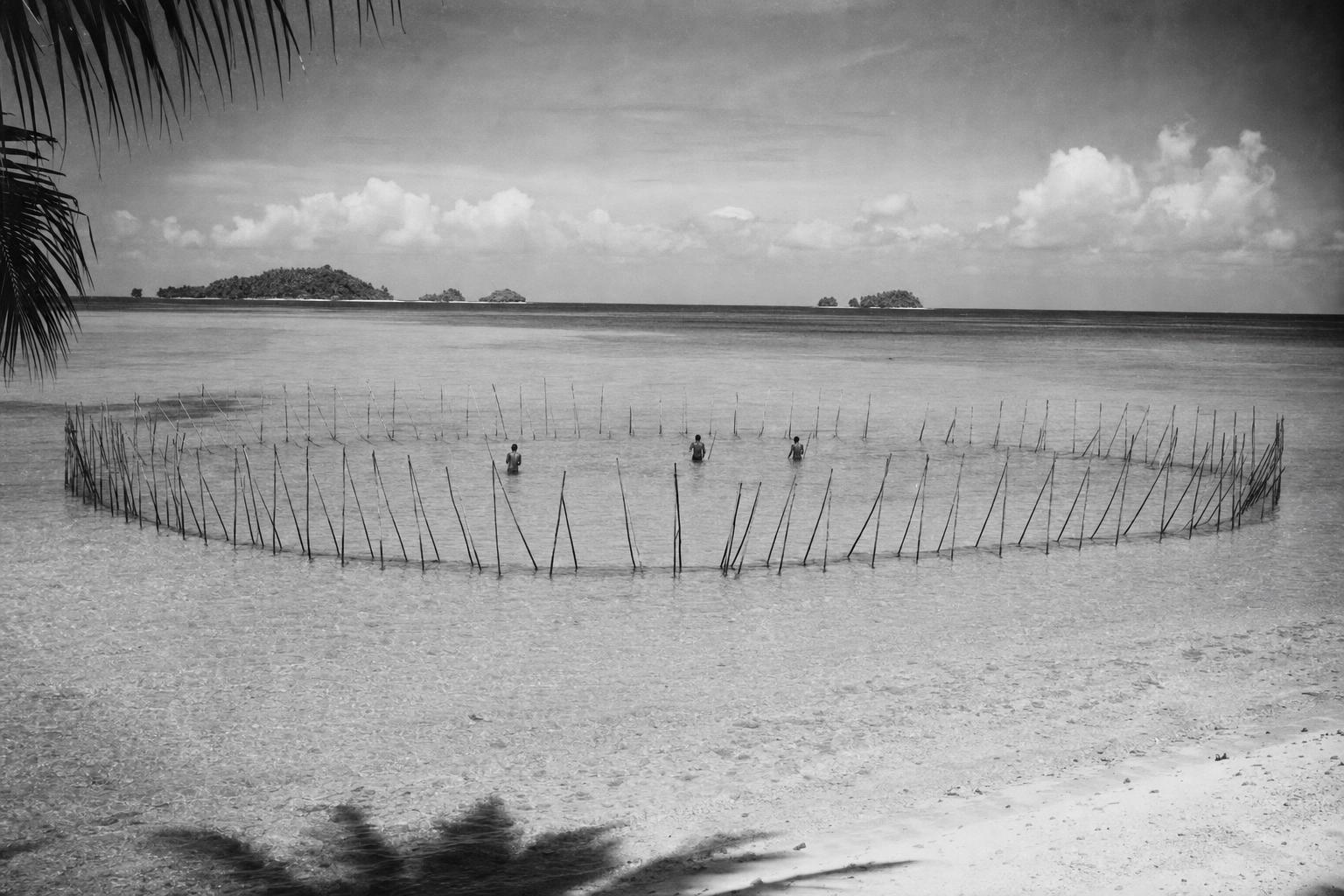
Paddy had a wonderful time sailing his fleet of palm leaf boats, learning to swim and scooping up the tiny fish which skittered along on the surface of the water. While Tomasa sat with the children, her son-in-law Benito took Barbara, Ren and me to the fish traps and taught us how to spear fish. Ren soon learned but Barbara and I were slow. The trap was a quarter of a mile from the beach. It was fan shaped and made of bamboo wood poles which were thrust into the sand very close together. They were about a foot taller than high water level. The line of poles converged on a bamboo purse at the handle of the fan. The fish swam unsuspectingly up the wide entrance of the fan and through the narrow opening into the purse. Once inside, few found their way out again. The traps were about two hundred yards wide across. At low tide the fishermen speared or netted the captured fish.
It was delicious standing in the warm water of the trap peering through goggles at the fish darting about on the sandy bottom. It was like being in an aquarium. Flat brown paluds with crimson thumb marks on their gills. Kingfisher blue coral fish and little rainbow fish endlessly and unsuccessfully sought escape. I never really became good at spearing them because what I really liked to do was dive down and swim amongst them and forget all about spearing them. I could feel them sliding past my legs or wriggling in the sand under my feet. We spent many happy hours in the trap. Soon I became so brown that any Japanese could have mistaken me !or a Spaniard or a Mestiza. It was wonderful to be beside the sea again, away from the mosquito ridden bamboo groves we had been hiding in.