Barbante took us to live in a house by ourselves not long after the meeting with his old father. It was considerably bigger than Rosa's but, like it, was built in a clearing amongst the coconut palms with a dense mass of bamboos behind it. Nothing grew on the barren red clay around the house and in dry weather Paddy and Stiffy played there but during the rains it was impossible to step outside without going ankle deep in the tacky clinging mud.
This house had another lean-to beside the kitchen, and this Barbara took as her room, curtaining it off with a blanket. There was the luxury of a table and a few chairs, provided by the old man. In the kitchen stood a big wooden box filled with hard clay on which the fire was laid for cooking; smoke drifted out through the windows. The house belonged to Barbante's brother who had gone north with his family for the fishing season. Remembering those years spent in the islands, they seem made up of weeks and weeks when time stood still, and it either rained incessantly or was unbearably dry and sunny. I can hear the wind rattling now in the dry bamboos and the sound of the sea sucking back the shingles on the beaches. Fish and rice seemed to have been our staple diet since we were born so accustomed to eating it at every meal did we become.
It was in this house that we really started to live like natives. Ren learned to climb coconut trees and cut off the golden nuts. Laboriously we husked and shredded them and made oil for cooking and lighting purposes. We learned to make soap with the oil and lye from wood ashes. Ren chopped wood daily with an axe given to him by Barbante. We lived and ate just as the islanders did, carrying water to the house for cooking, but washing clothes and bodies at the water hole. Soon I felt I'd always lived like this without servants or the usual comforts of a normal civilised life. We were provided for and if we hadn't to know what was going on outside this little world, we could have lived as happily as our friends did. Only Barbara, Ren and I, were curious about the rest of the world, the islanders gave it hardly any thought at all. Cagrary island appeared to us to be a safe place and all of us relaxed a little. Barbara and I were not so snappy with each other, the children were happy and comparatively well fed compared with the start of our wanderings. Ren carved little boats and fish traps for them and made them balls out of rattan, he made a bamboo cot for Stephen, who was six months old, and a hammock for us to swing in. The days were not really idle though they seemed endless. The few islanders who knew our hiding place kept away from us except Barbante who brought food, and so we began to feel confident that no unfriendly person would report us to the Japs who were by now well established all over the Bicol Province. But it was not so, and one night our peaceful life came to an end.
Creaking bamboos, the call of a night bird, wild cats in the undergrowth often kept me from sleeping, but this noise was quite different. It was footsteps pounding along the trail towards the house. I shook Ren and he got to the door as the runner arrived at it. It was Barbante to tell us the Japanese were coming to the island to look for us, at dawn. Someone who hated his father had told the Japs where we were hiding. Out of the house we had to go immediately and hide again. No time to take anything with us, just milk for the boys and water for us. Barbara was ready by the time Ren and I dressed ourselves and bundled up the children. Again we followed the leader along the trail. I was grateful it wasn't raining but the moon was hidden in heavy clouds and only one or two stars shone. The trail led downwards towards the sea, very narrow and overgrown with vines, then it ended and I was conscious of a vile smelling vapour rising from the ground as if we were on mudflats and realised we were at sea-level in the desolate Nipa swamps. Crossing a narrow salt water gully Pedro hurried us to the middle of the swamp. Here on a small raised patch of dry ground, densely surrounded by Nipas he stopped. In the feeble light shed by the oil flare he carried, the place looked evil. Ren and he cut the tops off a few of the smaller palms and made a shelter by throwing over it a tarpaulin. Pedro told us to stay under the shelter, and not to leave for any purpose until he returned. Wishing us luck he went back to his father's home where he said several families were meeting so the men could be together when the Japs landed. Stiffy had wakened up as I scrambled down the trail with him and Paddy had been awake since we left the house. I gave them milk hoping they would both go to sleep again. It was still dark, but judging by the birds twitterings, day was near. Paddy curled up beside Ren and was soon asleep, Stephen took a little longer. Ren had brought a blanket to cover them up and in it he had rolled the bottle of whiskey he said he hated to leave it for the Japs! The sky lighted and we sat and listened for the Jap launch. Pedro thought they would arrive about six o'clock as the reef was crossable then, and if they wanted to return to Tabaco that day, they must leave about ten in the morning. They never stayed after dark on the islands because there were no roads and they could be ambushed easily.
Both children wakened at daylight. Paddy sat rolling and unrolling our last precious toilet roll and Stiffy (so called because that was the only way Paddy could pronounce "Stephen" when he started talking) crawled off my knee and gurgled happily as he explored yet another strange place. Pedro had warned us not to talk as every sound carried upwards from the hollow we were in. Barbara was quietly tearful. How often she must have regretted the fate that left her with us in Legaspi.
Tensely listening I still found time to pray to St Christopher to deliver us again from peril. After all, he is the Patron Saint of travellers! I watched the children so I could anticipate any noises from them. Then distinctly we heard the putt-putt of a motor launch, only the Japanese had gasoline to use in launches. No one had a watch but I guessed it must be about six o'clock. I could imagine the scene at the beach. The women and children with their precious pigs and fighting cocks must have gone away to hide in the trees. All the houses would be shuttered except old Mr Barbante's. He and the other old men of the barrio would be standing in the doorway waiting for the launch to anchor. The putt-putt stopped. Nothing disturbed the early morning stillness until the dogs began barking; then we knew the hunt had started from house to house because under each one there was usually a watch dog tied to one of the houseboats by a piece of rope. They whined or barked frantically if anyone approached. I was petrified, now the search really had begun, and held Ren's hand tightly and prayed for courage. Paddy went on quietly playing with his roll of paper but Stiffy soon tired of crawling around, and began to whine. I tried to quieten him, realised I had given all the milk too soon and had nothing to soothe him with. The whimper changed to a bellow. I was certain the noise would carry for miles. Discovery was certain if it continued. Ren, resourceful as ever, poured some neat whiskey down the struggling infants throat. Astonished, he stopped crying spluttered quite a bit, turned crimson, then buried his protesting head on my shoulder and sobbed quietly. Five minutes later he was in a drunken slumber. St Christopher, I thought, and giggled weakly.
The cries of the searchers came nearer, the dogs barked and we could hear movements along the trail above us, branches snapped and trees rustled. Once the voices stayed directly above us and peering from under the tarpaulin Ren saw, about seventy yards away, the back of a soldiers cap and motioned us to be very still. Presumedly thinking the swamp was impassable he moved back up the trail and continued searching along it. Gradually the voices died away, the dogs stopped barking and all was still again. For three hours we sat and waited to be captured, or else to hear the putt-putt of the departing launch. Just as we became confident that the search must be over, shot after shot rang out from the direction of the beach. It sounded as if the Japs must be shooting everyone they could find. Ren said it was no good us all going down to find out, but that he would try and find out what was happening himself. The shooting had stopped, and as Ren started through the swamp, we heard voices, and Augustin and Pedro came hurrying towards Ren shouting "Jesus, Maria, Joseph", "A lucky day", "The Japs have gone."
Pedro told us all about the search while we stretched our cramped legs. Stiffy still slept drunkenly on the mat. Old Mr. Barbante had met the squad on the beach and when they wanted to know where we were, had told the interpreter to say we had left the island many days before, and how glad he was to get rid of us. We had gone to Catanduanes Island he said. Of course the soldiers did not believe him and demanded to be taken to his house where they searched thoroughly, thrusting their bayonets through sacks of copra in the little warehouse in case we were behind them. Then they searched every house they could find until they came to the one we had lived in. They seemed to know this was the place they were searching for because they screamed and raged and completely destroyed it by thrusting bayonets through the Nipa walls and roof. Old Barbante insisted we had left the island and were on Catanduanes. At last the order was given for a return to the beach, where they had staged a shooting match. A coconut was thrown out into the sea as far as possible and each soldier shot at it. Pedro and Augustin roared with laughter when Ren said thought had all been shot. While we ate the fish and rice Pedro had bought and the children drank some milk, Mrs. Barbante had thought of, Pedro said we must leave the island as it wasn't safe to stay any longer. They would take us somewhere else at midnight; in the meantime we must stay in the swamp. They would collect some bedding and anything still usable from the house. Pedro said we had not heard the launch leave because the wind had changed and he was afraid more rain was coming.
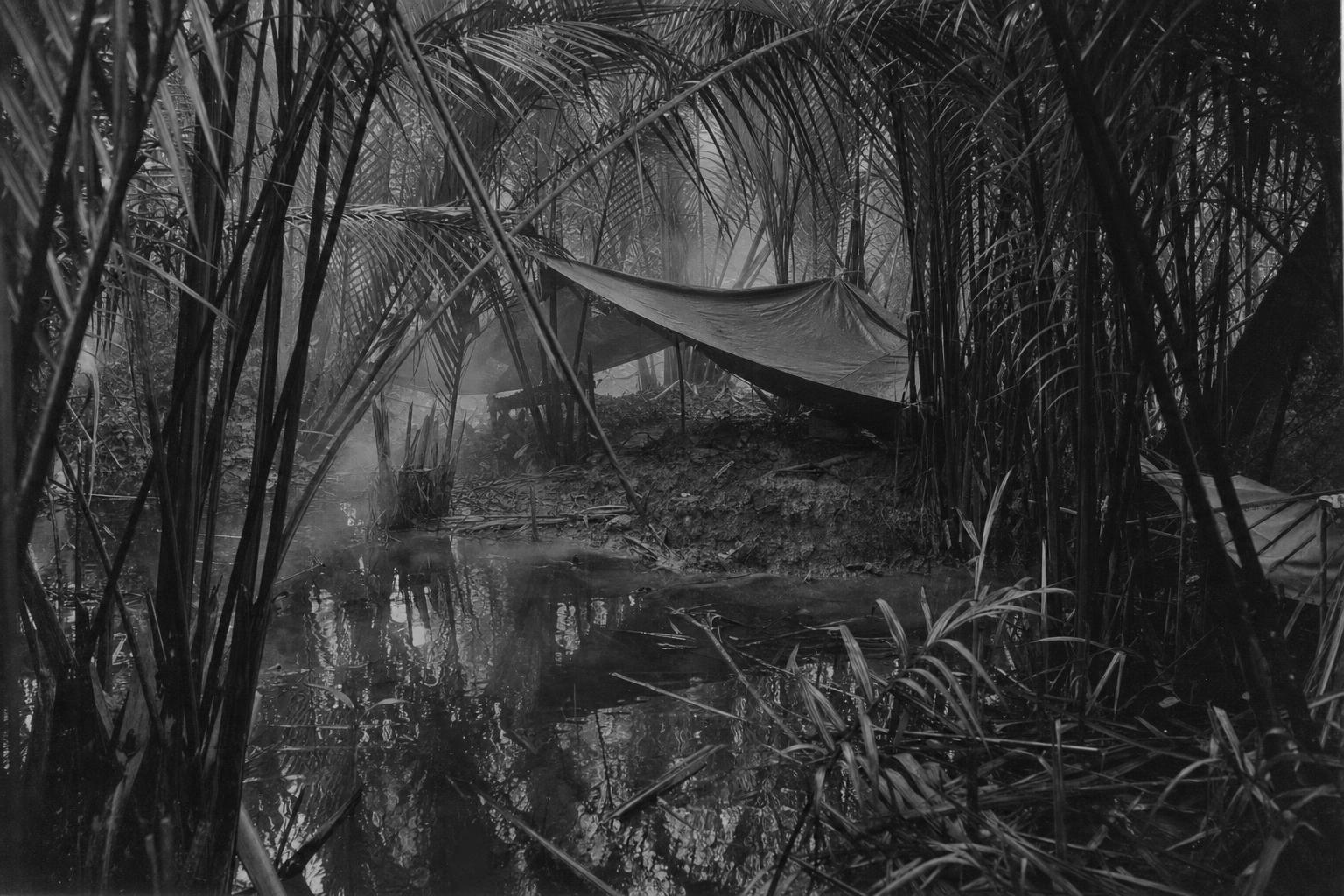
The rest of the day we spent dozing uneasily in the oppressive heat; at noon the smell from the swamp was appalling. At dusk when Ren lighted a coconut oil rag flare and rammed it down in the mud, it seemed to me as if we been sixteen weary days in the place, instead of as many hours. It began raining steadily as we waited impatiently for midnight. The children slept uneasily, rolled up in the blanket.
Pedro and Barbante carried flares to guide us up the trail but the wind was strong and the rain swept down steadily and several times the torches nearly went out. Mrs Barbante had prepared a meal for us at their house and more food was wrapped in banana leaves for us to take with us. Goodbyes were said to the kind old man, and the women kissed and embraced Barbara and me and the children and wished us Godspeed. I knew we could never repay them for their fearless help.
To our surprise Daramas and Anacleto were to take us on this journey. How I had misjudged that little man. While he lived he was to be a staunch friend to us. They had decided to take us down the coast to the other end of the island which was practically uninhabited. A cousin of Daramas's called Tomasa lived at a lonely place called Gueron and she was certain she would take us in. The rain stopped as we walked down to the banca, but the wind was still strong.
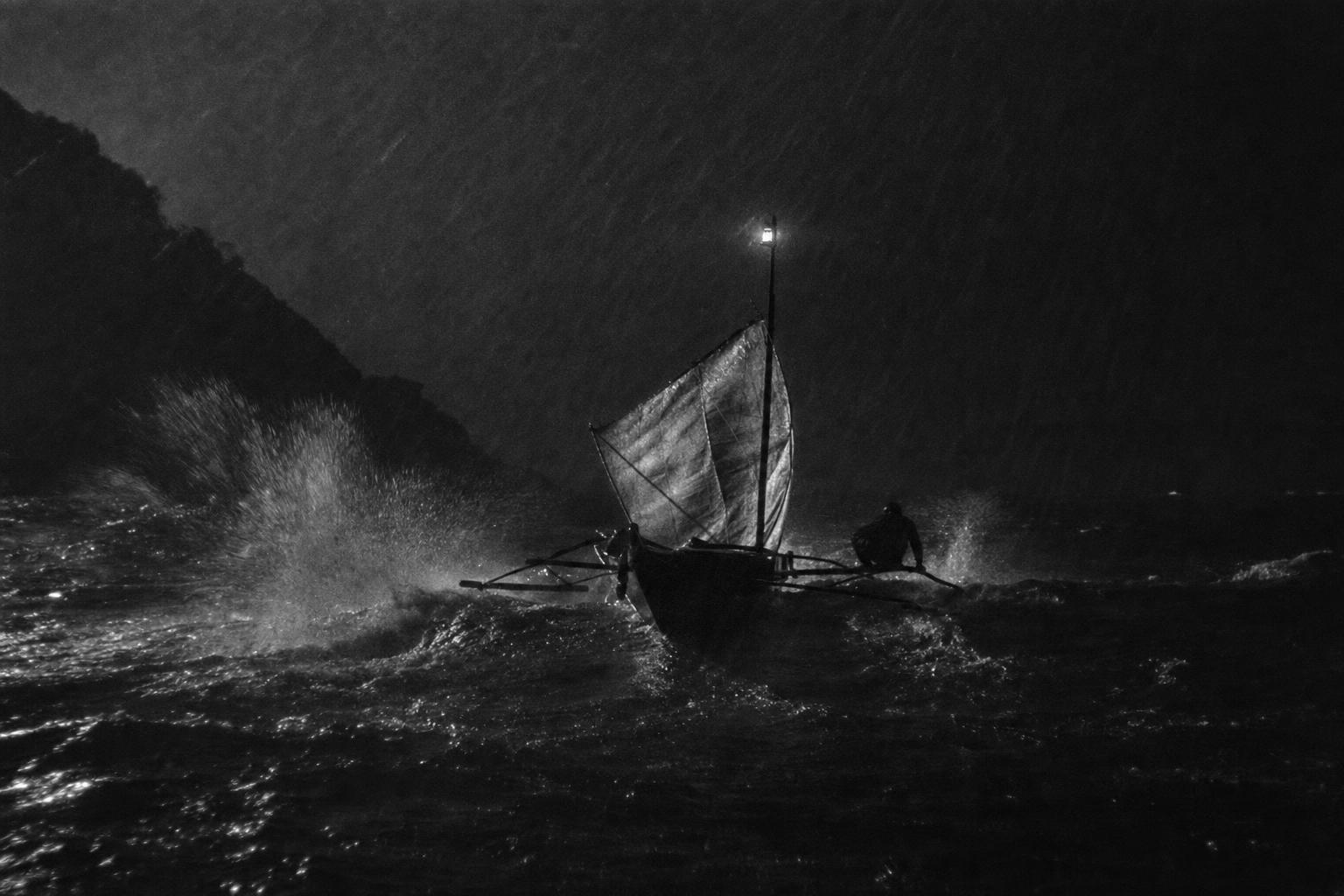
Deep black waves menaced the frail boat as we scudded in and out of the troughs of water following us, but never quite catching us. The sail was well reefed and Daramas squatted like a little monkey on the out riggers when ever it was necessary to trim the boat. These outriggers are made of an extremely strong type of bamboo, and are lashed securely to the boat with bejuca vine. All of us had to hold on tight; Ren and I wedged ourselves on the bottom of the boat, each nursing a child, that way it felt safer than on the bench. Barbara was also on the deck holding onto the mast. Daramas bailed continuously and tried to watch for reefs in the dark. There was a small oil light at the masthead but it wasn't much good to see by and only magnified the size of the waves. The noise of the wind and sea and the creaking of the boat was terrifying, and I was afraid Gueron would never be reached.
Just as daylight came Daramas sighted Nagtapia Point round which we had to sail and enter Gueron. Abeam of it Anacleto went about and at the same time there was a tremendous crack - the bejuca binding had broken on one of the outriggers and the boat began to capsize. Anacleto and Daramas grabbed the outrigger and pulled it towards the boat while Ren hove her to. She righted herself but tossed about in the heavy sea while Anacletto made a rough repair with the rope. Only the speed with which he and Daramas had grabbed the outrigger saved us all from drowning. We could not have swum for long in that stormy sea.
Once around Nagtapis it was relatively calm. All of us were soaked and our teeth chattered helplessly, but we felt better when Daramas pointed to a house about a mile away and said it was Gueron. Inshore the water was calm and the boat skimmed along and soon Anacleto bought her into the sandy beach.
A woman watched us from the steps of the house as we trailed dejectedly behind Daramas. When she recognised him she started talking loudly in Bicalona, and after he had answered, Tomasa came to meet us, smiling a welcome and taking Stephen from my arms, she led us into her house. There she and her pretty daughter Rosario brought us food while Daramas explained all about us to them. Afterwards Tomasa took away our wet clothes and gave us sarongs to wear while we lay on the mats and pillows Rosario had spread for us on the polished floor.
Tomasa said we could stay with her as long as we liked. Anacleto and Daramas left the next morning. We gave them messages for Macabao, begging him to come soon as we were desperate for news about Europe and the Philippines. At first when we heard Singapore had fallen we refused to believe it and said it was just Japanese propaganda. When this news was confirmed four days after, it became our one topic of conversation; how it could possibly have happened, and of course it confirmed our growing suspicion that we would be hiding in the hills for a long time.