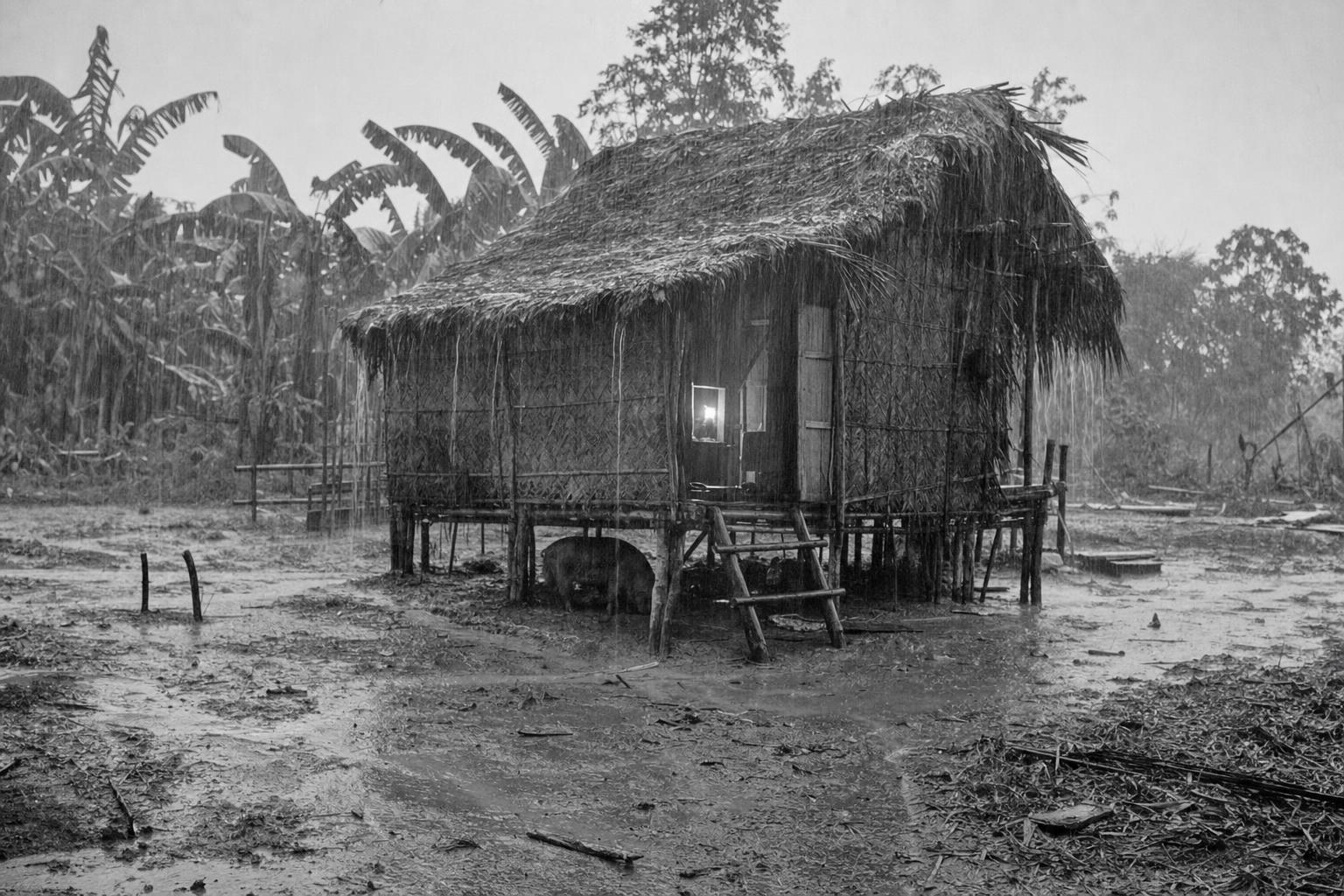
How kind, but oh how dirty Rosa and her family were!! It must have been a week that we stayed in her house and it rained all the time. Whenever we had to leave the house even for a few minutes we were soaked on our return. Bathing, or even washing was most uncomfortable. Rosa and the children hardly ever washed. One little boy was covered in empetigo. Rosa always wore the same soiled sarong topped by an equally dirty camisole and her long black hair was tightly coiled in two plaits around her head. She was a pretty and vivacious woman. Pedro was unsmiling and hardly ever spoke to us. Their little boys wore tiny abaca shirts which came down as far as their little brown bottoms. They played happily inside the hut all day, not even going outside to attend to the needs of nature, there was a little convenient hole in the bamboo floor in the corner of the kitchen.
The days were boring; nothing to read, or sew, no house work to attend to and no news of any kind to occupy our thoughts. Ren suffered most as I could play with the children and tell Paddy stories. Barbara became so unhappy and so irritable with the overcrowding, that Barbante took her to stay a few days with his father and mother nearby.
Though I got scared going to the water-hole to bathe it was a relief to dash down there and be alone for a while. The bathing system was to fill a kerosene can with water and take it a little distance from the hole, and then using an empty coconut shell as a dipper, pour the water over ones body. It was icy cold and the rain drops felt warm in contrast.
Macabao hadn't come to find us as he had promised; Alvarado and Pedro and their families were living on the island and never left it so we simply had to wait day after day hopelessly waiting for news from the mainland. Little Daramas had disappeared the day he met us on the trail and was supposed to have gone to tell Macabao where he could find us. The rain never stopped night or day; the clearing around the dripping little Nipa hut was a sea of slimy red clay. All night the frogs chorused outside it.
Early in February Barbante took Ren to visit his father. He lived in a big wooden house with a tin roof, a sure sign of wealth amongst the islanders. The house was right on the beach. The kind old man assured Ren we were most welcome to stay on his land and that he and his sons would protect us and never let the Japs take us prisoners. Already he had arranged with a friends who had gone to the mainland to warn him of any impending Japanese search for us. Here was this old man who had never seen us before and who knew nothing about us offering us a refuge for as long as we liked to stay with him. He said he would feed us too when our rice sack was empty. The old familiar "You are welcome Mam" didn't make us smile now. We knew these people meant it very seriously; that the Japanese would punish them and probably destroy their homes if they were discovered by them harbouring us didn't worry them a jot. The old man and his sons were convinced that the Japanese would soon be chased out of the country and then Barbara could join her family and Ren and I and ours go home to Legaspi. They were childlike in their belief that America was coming quickly to the rescue of the Philippines. That the war could turn out to be a long bloody business did not worry them. They were naturally a happy carefree people living from day to day. We could live like them too, until peace came. In the course of our wanderings we slept in fourteen different Nipa huts and were always welcome and given the very best our friends could provide. We slept on the floor at night alongside them, and they fed us from their meagre supply, and while we had money they were reluctant to accept it. Yes, "You are welcome" had a real meaning.