For a time after their arrival on the island the Guerrillas were the main topis of conversation. Ramon told us where they were, that they drilled and practised all day long, that they had hardly any ammunition and were waiting for some to be sent to them from the south. At first the Islanders welcomed them, but after the typhoon when food became scarce they grumbled that the Guerrillas took everything from them, even going into the houses and taking away blankets and mats. They became extremely unpopular when the Japanese made several visits to the island to try and catch them. The Japs had stopped using launches and came in native sailing boats, so it was difficult to foretell their arrival. Generally it was early in the morning and they left at dusk though they had spent one night at Tambilago. Several times Andre had come up from there to tell us a party of Japanese soldiers had just landed and were searching the surrounding barrios. Mari remained in the hut but Barbara, Ren and I and the boys took some food and hid in the abaca plantations until they left. These excursions were pleasant picnics for the children but I spent the hours praying to St. Christopher to save us once again. At night when the Japs had gone back to the mainland we returned cross and weary and very itchy from the mosquito ridden plantations. These raids continued for some time until the guerrillas moved away from our part of the island. We were very thankful as we hoped it meant peace again and more food; we were tired of camote sprinkled with coconut which had become our main diet since the typhoon. Camotes are sweet potatoes in America and kumaras in N.Z.
But we were not to sink back again in to the peaceful life we had become used to. One day a band of men came to our hut; we heard them running up the trail and shouting long before they arrived. They were quite breathless when they got up to the hut and blurted out that they were guerrillas and that the Japs were about to raid the island and we had better get off it immediately.
One of these men came inside and introduced himself as Captain Flor. He was very anxious that we leave the island because he said the islanders would blame him if the Japanese caught us because until the Guerrillas landed on the island we had been quite safe. Ren replied that he thought we were still safe enough but Ramon and Ipang and the old couple joined in the discussion and said they would like us to go somewhere else until the Japanese had searched the island as they were all very scared of what might happen to them if we were discovered. Flor said the Guerrillas were moving away from the island for good very soon and then we could return to our little hideout.
Ramon took the matter into his own hands by telling us to pack a few things and he would take us to stay for a time with his Aunt Inday over on Namondie Island. We could not argue with him because the last thing we wanted was to cause him and his family distress, so reluctantly we agreed to visit.
Inday lived in quite a big house about a mile from the landing place at Namondie but she had a large family and though she welcomed us kindly she was obviously startled by our arrival and must have wondered where to put us all when we arrived at dusk. Preparations were already being made for bed. On the floor four small boys were lying under a large net and Inday was about to join them. In a corner a beautiful young girl was nursing a very tiny scabby baby. Ramon said she was Inday's eldest daughter and the young man lying beside the hammock was her husband. Inday was a widow. All this Ramon told us as he helped Ren to fix up our nets in our allotted places, while Inday kept up a rapid conversation in Bicalano with him. Meanwhile the young couple and the baby joined her under the enormous net. Ramon bid us goodbye promising to come to see us soon, and off he went leaving us with this strange family, only one member of which spoke English/Spanish.
We undressed by the light of the flickering oil lamp; Barbara crawled under her net in the corner of the room and Ren lay down under our net with Paddy beside him and Stiffy next to me. Inday said that she did not wish the light to be put out.
Looking about the room in the flickering light, I noticed a lean-to at one side of it, and wished we had been invited to sleep in it. It appeared to be locked and I supposed the household effects were kept in there. The lamp made more eerie shadows on the wall, insects rustled in the nipa roof and frogs croaked loudly outside. It was a long time before I went to sleep and it seemed to be no time at all before I was awakened by mad laughter ending in high screams. Sitting up in terror I found someone with long long hair bending over me, gesticulating wildly at Stephen sleeping peacefully beside me. I let out one awful yell and pandemonium broke loose as Ren leapt up out of the net, Inday and the young man bounded out of theirs shouting to the figure still hovering beside me. In a second they grabbed the woman and pushed and pulled her protesting and shrieking into the lean-to which they locked. I was shaking with terror as I clung to Ren and the children.
Inday came to us and matter of factly stated in a mixture of English/Spanish that the woman was her mad sister who was normally kept locked up in the lean-to. Most of the time she was quiet and amenable but occasionally she had to be tied down with ropes. Our arrival must have upset her, perhaps she had inspected us through the crack in the door and waited to inspect us more closely until everyone was asleep. Someone had left the door unlocked but now we could sleep peacefully as it was padlocked. It all sounded so casual an explanation and as though it was quite normal to have an idiot included in the household. Inday bid us goodnight again and everyone settled down once more on their mats. I spent the remainder of the night waiting for the lean-to door to open.
For three long dreary wet weeks we stayed at Namondie while the Japanese searched unsuccessfully for the Guerrillas. Forced by the weather to remain cooped together in the one room I thought I would soon be mad too. Inday cooked and cleaned and sewed all day while the lovely girl lay indolently in the hammock with the babe, her husband on the floor at her feet, endlessly plucking tunes on his guitar. The children played and quarrelled together as children do in wet weather all over the world. There was nothing for Ren, Barbara or I to do except irritate each other. Mari had stayed on Cagrary with Auri so at least I could take care of the children.
The scabby tiny baby was six months old and he had never once been bathed in all that time. His mother wore the same clothes night and day all the time we were there. No wonder the poor mite had impetigo. I had some mercuri chrome and zinc ointment one of our friend from Catanduanes had sent us and so I suggested to the mother that she should bathe the baby and then we could put the ointment on the sores. She was horrified at the idea, then agreed to it but backed out when she discovered it was a Wednesday. The babe was born on a Wednesday and it would be folly to bathe it as all sorts of bad luck would follow. A few days later she reluctantly agreed to my bathing the babe, and the sores gradually got better as my precious ointment was used up.
During our stay with Inday, all of us had dysentery and it became a nightmare rushing out frequently day and night into the dripping plantation. How I longed for a pull-the-chainer!!
I also knew for certain that I was pregnant and that the babe would be born in September. I vowed that if it should be a boy I would call him Christopher in honour of the Patron Saint of our travels. Both of us were happy and hoped that by September the Philippines would be free. I refused to worry about clothes for myself or the babe; time to worry about that when they were needed urgently.
At the end of February we said goodbye to Inday and returned with Ramon to our little house high up on the hill.
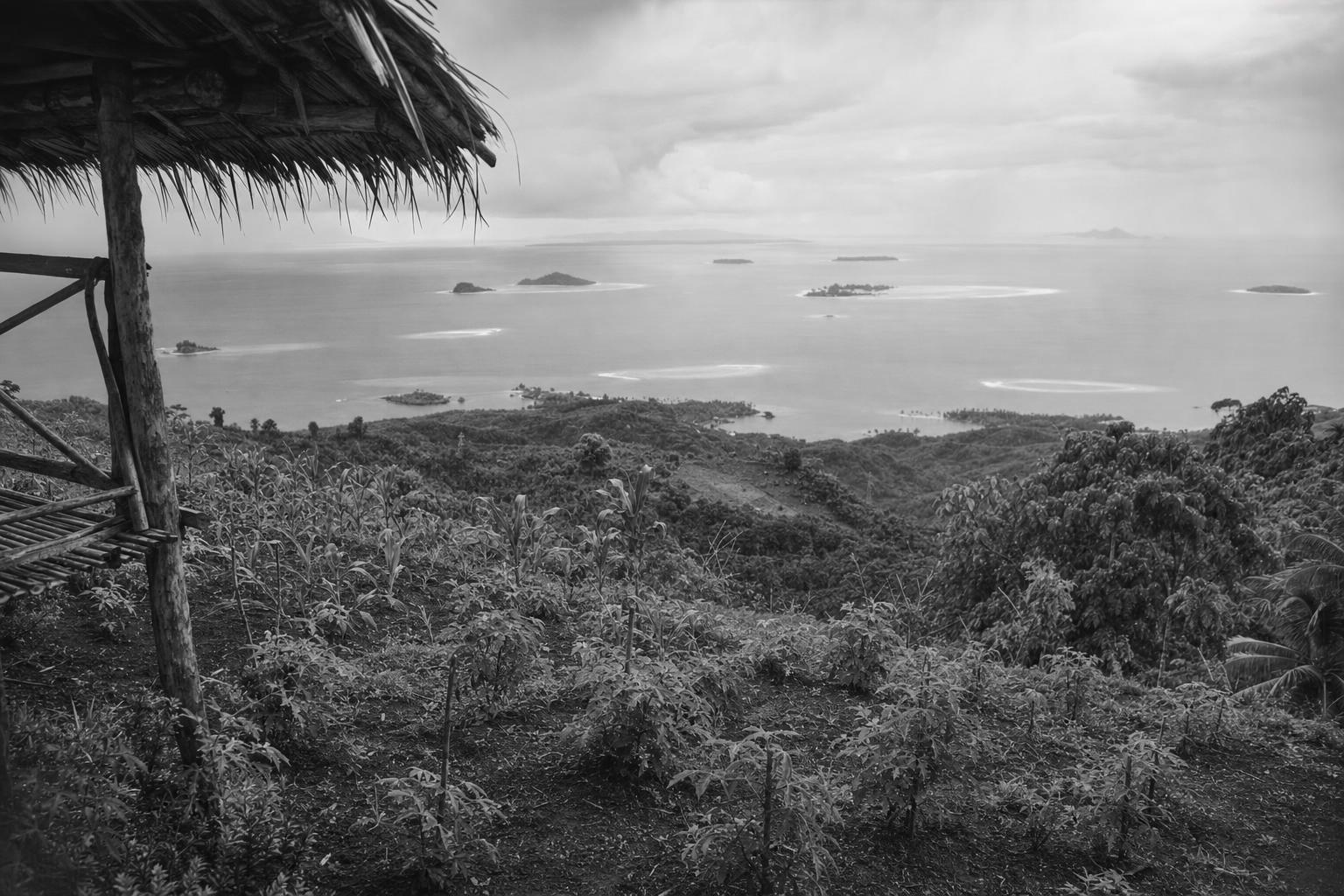
How heavenly it was to be home again, and from the verandah look out to the white reefed islands dotted about the blue seas far below us. The lattis near the house were green with young corn and in our own little garden the tomatoes were turning red and the beans were ready for picking. Ramon brought back to us our little pig and our chickens and Mari returned from her visit with Auri. The household was re-established.
The guerrillas had left the island and once again Ren could paddle down to Liquan to hear the news; he went alone because Mari was afraid to be left at night in our isolated little house. We did not move about very much because the Japanese still made unexpected visits to the barrios.
The hot dry season started and the days dragged on monotonously. We felt trapped for ever in this lazy torpor. Books, music, other people, seemed too improbable to contemplate. Beauty was all around us but oh how I longed for England in the Spring time. Visions of daffodils and the woods full of bluebells.
Very few of our friends came to see us because there were more Japanese about and travel became difficult and they knew it was safer for us as well as themselves if they stayed away. Macabao did come and Barbara persuaded him to take her home to San Miquel because the Japanese had taken all the cattle away and never went to the island any more. He reluctantly agreed it was safe but promised to bring her back to us at the first sight of danger. A few weeks later he sent us a message with the news that she had decided to go and live with the guerrillas and was at a certain place on the next island to us. There the guerrillas had built her a house. Barbara asked that if we ever contemplated moving far away to contact her and she would come with us. I am sure she was happier on her own although amongst strangers. Of course we always called her from this time to the end of the war "The Guerrilla Queen" and invented the most impossible adventures for her.