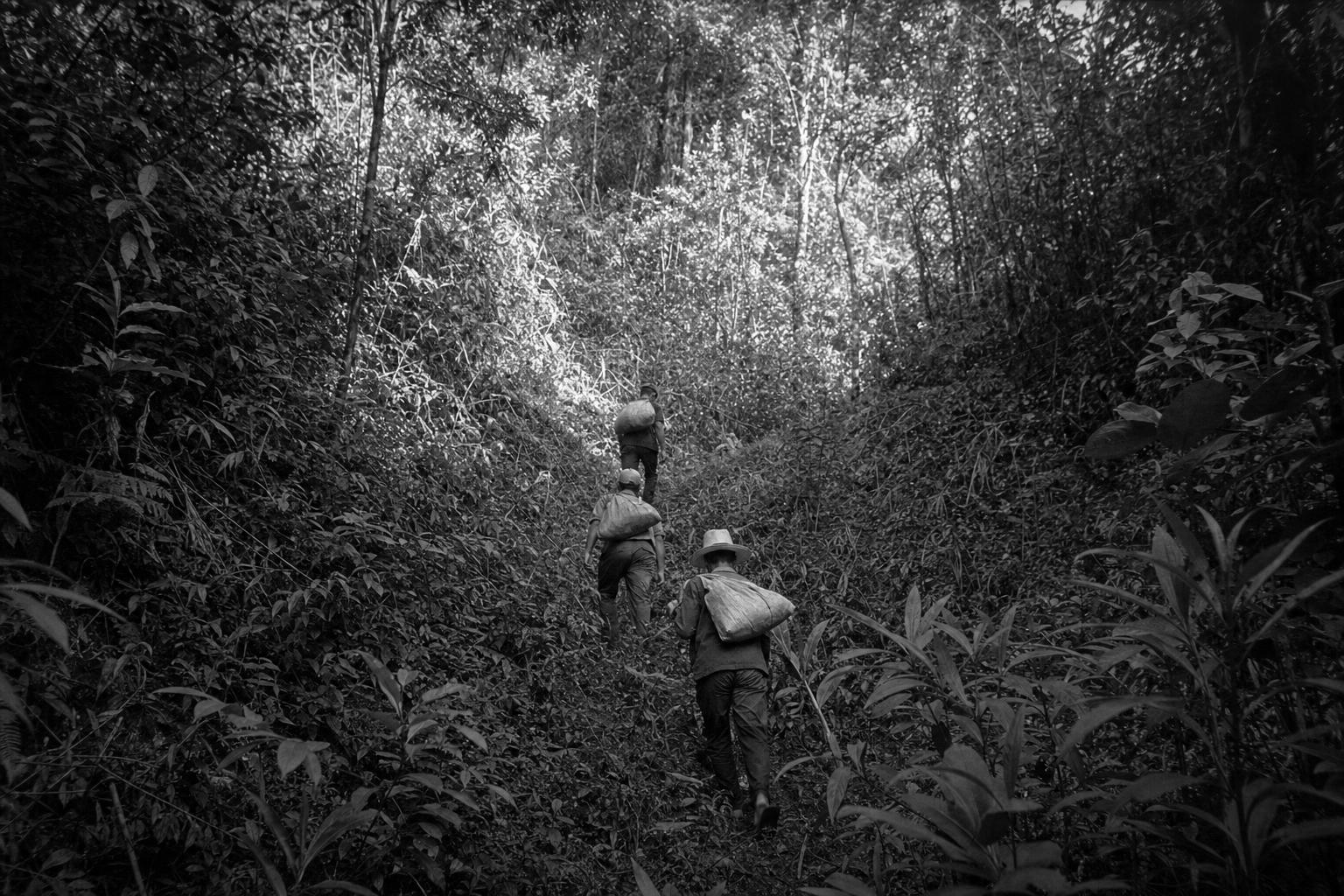
The wet weather began in November and our excursions were curtailed although we still paddled to Liquan once a month to hear the news. On one occasion Ren went alone as Stiffy had a cold and I preferred to stay with him, and he had the startling experience of entering through Mr. Salesby's back door as two Japanese left by the front one. They had paid an unexpected visit to the mine, and engine trouble in their launch had delayed their departure. After that experience we were always careful to scout around before going to the house. I remember that night the radio news was good. Rommel's army was retreating, Tobruk was retaken and nearer to us heavy fighting was going on at Guadalcanal. I would visualise war going on in other parts of the world as I lay on the floor of our hut thinking about the radio news, how I longed to be in England. Christmas time and the Guerrillas came together. There were no preparations for Christmas except that Ren made a few toys for the children. Funds were low, and we had hardly any rice left and we felt depressed at spending another Christmas on the island. Freedom seemed further off than ever, although the news was so much better in Europe the Philippines seemed out of the picture completely.
A few weeks before Christmas Juanito came over the hills to tell us about three hundred guerrillas hiding and training on the island and that it would be safer for us if we stayed at home altogether as the Japanese were certain to have spies on the island and they would find where we were too. We were more depressed than ever because as well as keeping us home, it meant we would soon have a shortage of food as the guerrillas commandeered all the fish and fruit available while the Japs stopped any boats taking foodstuffs to places they knew were used as hide-outs by the guerrillas. Nevertheless we did celebrate Christmas happily. A few days before it, Vicente, our boatman in Legaspi, arrived at our hut. He was a villainous looking man and he came three times all the way from Legaspi to see us before Tomasa trusted him enough to guide him to us from Gueron where he landed. She bought him to us that day because his little boat was laden with gifts for us, from all our friends in Legaspui. His dark pock-marked skin and his face marked down one side with a deep purple knife scar certainly was ugly and evil looking enough to make Tomasa hesitate to bring him to us, but his brown eyes were kind and gentle, and he wept as he grasped Ren's hand and exclaimed how the children had changed. His brother, whom Ren had once bailed out of gaol, was with him too and between them they made two journeys down to Gueron to bring up all the gifts for us. Foodstuffs unthought of for a year were piled in our little house. Twenty-four pounds of lard, thirty pounds of margarine, three dozen pieces of toilet soap, white sugar, three rolls of cotton wool, a bottle of eau de cologne and to our joy a few old Readers Digests and Life magazines. Most of the things were sent by a Spanish friend who owned a combined shop and bar. What luxury we lived in for months and how we all read and reread those magazines.
Vicente and Alejandro were unable to stay long as they wanted to get back in time for Christmas with their families but they slept the night with us and we questioned them about all the people we knew in Legaspi. Vicente told us the Japs were using the Vixen to take their girls out in, but they had cut off the mast and used the motor only, that she needed overhauling badly and repainting. All our friends were well and sent us love and messages of hope for the coming year. We in our turn gave Vicente messages of love and thanks for them and told him to tell them what a wonderful Xmas we would have because of them. Early in the morning they left us. How I envied their freedom as they set off down the trail.
The morning of Xmas eve we were sitting outside under the trees talking of other places and other Christmas's when we heard singing down the trail and recognised the tune Noel, and into the clearing trooped Daramas, Augustine, and Pedro Barbante all singing lustily despite the fact that they all carried sacks on their backs. They stopped singing and Daramas called out "Here comes Father Christmas." They would not wait until I had cooked a meal for them but insisted on opening the sacks right away. Inside were gifts from themselves and from friends in Tabaco and Catanduanes Island. Most precious of all was half a sack of rice now practically unprocurable. There were cigarettes for the girls, pili nut candy and biscuits for the children, a can of onions, a jar of jam, hemp slippers for Barbara and me and five pesos from Mrs Alvarado. Ren's secretary sent him a bottle of whiskey and Daramas had brought a hen a hen and as I tearfully accepted it, I wondered if he'd stolen it from anyone. I could not thank them enough for bringing all these wonderful gifts or for coming such a long journey to wish us a happy Xmas. I shall remember their loving kindness to us as long as I live. Almost straight after lunch our visitors left as they wanted to be home before nightfall or as they said, before they were "benighted". Round the smudge fire we sang Christmas Carols and I remembered midnight mass in the little village at home and told Paddy and Stephen about Christmas trees lighting dark rooms and the story of Christmas too, and peace on earth.
Christmas day passed happily. The boys were enchanted with the fish trap and little boat Ren had made for them and played happily with the little shells and toy cigarettes they found under their pillows. Ren took them down to the pool to play with the trap and boat, just like any other father does on Christmas Day all over the world.
On Christmas morning we took some of our gifts to Tomasa. She was just as delighted as Barbara and I to smell perfumed soap again and to have margarine to cook with, and enjoyed smoking some of the cigarette Mari gave her. We visited Ramon and Ipang to wish them a Happy Christmas. Ramon had made a little cart out of an old soap box for the boys. As they had plenty of rice from their harvest we brought them onions, and soap and lard. The afternoon was spent was spent sitting under the waterfall while the children played with the boat and pretended they could swim far, always with one foot on the ground. At night we ate roasted chicken and onions and rice with pili nut candy dessert. When the children went to sleep at last, the three of us sat around the fire and drank a toast to a future freer Christmas yet to come. The whiskey tasted ambrosial.
After Christmas and the New Year had gone, monotony struck us again. The rainy season was depressing, to put it mildly. We were forced to spend long days together cooped in the hut. I hated the mud and the sodden trees and longed for the sun and the joy of walking through the lattis again. The children became as bored as we were playing with their few possessions. Stiffy used to sit above a small hole in the floor and drop pili nuts onto unsuspecting hens beneath the house. Recovering the nuts was a wet messy business but the game kept him occupied for quite long periods. It was about this time that I began reciting all the nursery rhymes I could remember to the boys and at night I loved to lie in the hammock with Stiffy on my knee and Paddy curled at my feet telling them fairy stories. Soon Paddy could recite many of the rhymes.
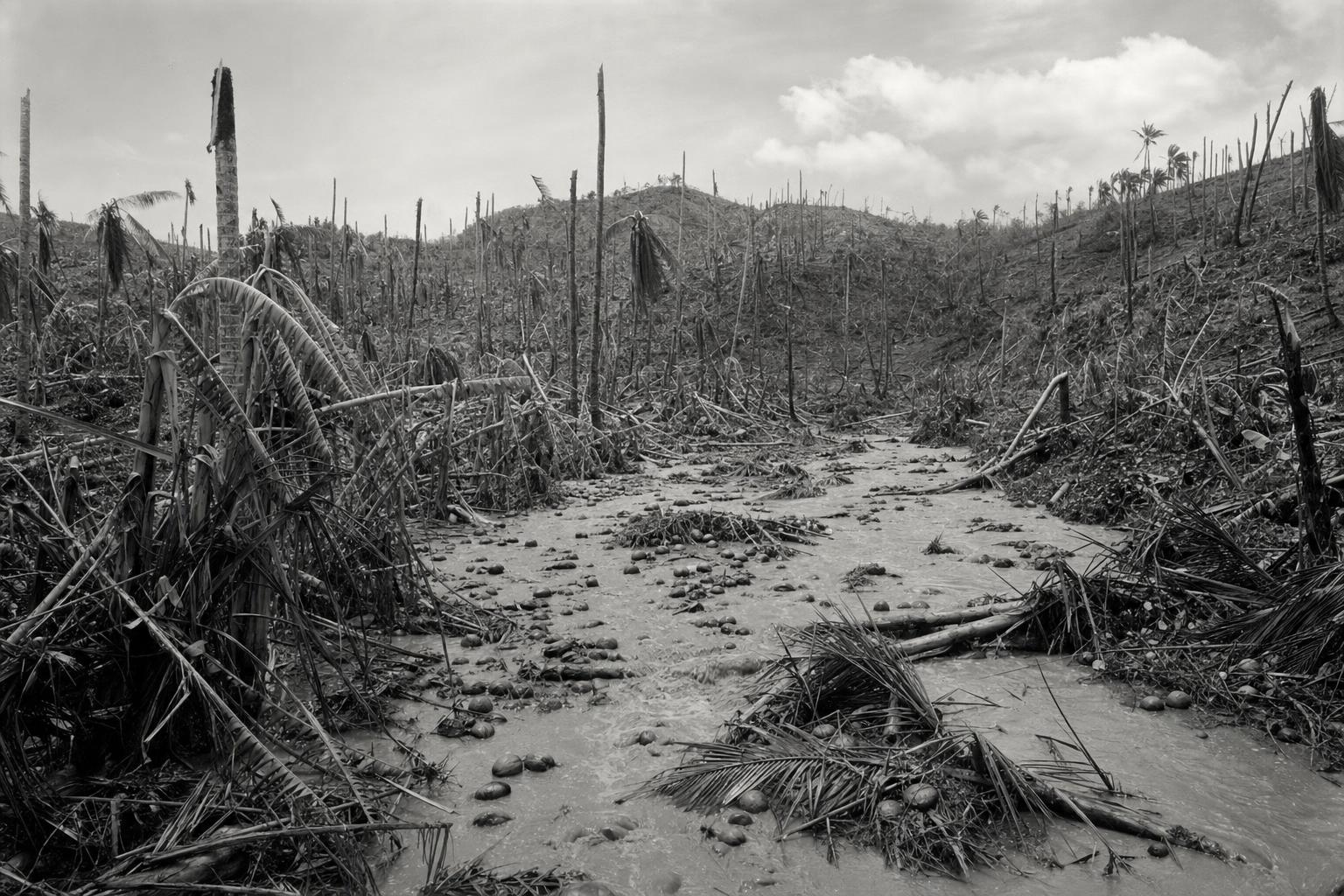
Late in January, a typhoon swept over the island. All day the wind roared around us, bending the coconut trees and snapping off the tops of the papayas but it was night time before the typhoon passed over us. I had experienced several of them in San Rogue but the old house always remained undamaged even if the sea was all around it and I was never afraid, but here, so completely surrounded by trees and so high on the hill, I was scared to death. The tiny hut rocked and creaked on its posts, pieces of the roof tore themselves loose and blew away, and the rain poured down on us huddled together in the dark. The wind shrieked so loudly no one could be heard speaking and as it increased and the noises of cracking trees, and the roar of the waterfall mingled with it, I could not comfort the children. They clung to me in terror all through the dreadful night. Day came at last as the typhoon passed. Through the openings where doors and windows had been, was a scene of utter desolation. Banana trees lay flat on the hillside, coconut palms stood leafless and nutless and the tops of the papaya trees were snapped off completely. The little stream was a surging torrent with the surface covered with tree trunks, branches, bobbing coconuts, dead chickens, bamboo frames and house roofs all swirling madly along together. There wasn't a break in the low dark clouds and the rain poured unceasingly onto the soaked earth and formed rivulets down the hill. As soon as he could Ren hurried off to search for Anna and her calf and found them both safe in a grassy hollow looking calm and quite disturbed by the noises around them.
The kitchen was under water so Mari lighted a charcoal fire in the room and cooked rice and eggs; the fire looked cheerful though the rain pouring in on us prevented us getting warm. Everything in the hut was soaking. At about noon the rain stopped for a while and Ren repaired the roof and made a new window shutter and door of nipa palm. I spread all the mats and blankets on the walls and tried to dry the floor. It was days before the rain stopped completely and we were able to hang our belongings outside to dry. When the rain stopped we were able to get out and see the devastation. Small huts like ours had been lifted up and blown down the slopes or half a house had torn itself away. The crops were beaten into ruin and fields of vegetables had just blown away in some areas. Trails were blocked by fallen trees or huge branches. The islanders reckoned it would be two years before they could harvest any bananas or coconuts. We gloomily thought of being without fruit or vegetables.
Some time after the typhoon, Macabao came to see us. He had heard that seventy-five per cent of the houses in Legaspi were destroyed by it, and the roofs of the Church and Convent were blown off but our old house was undamaged, though the sea had been chest deep around it. The Japanese had not remained in it during the storm but had moved inland to Albay.