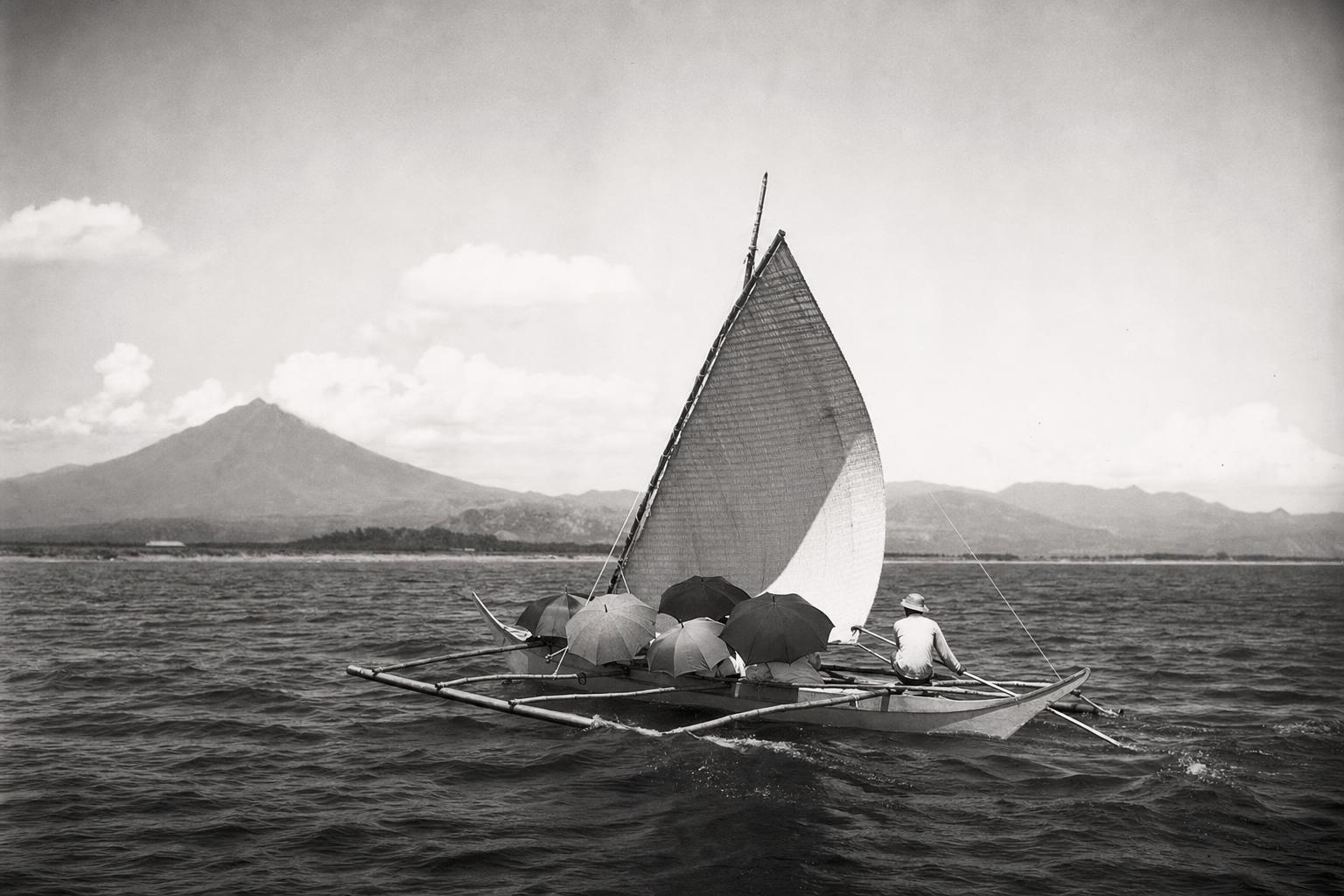
Twice the car was stopped by Japanese soldiers at strategic cross-roads on the way to Tabaco. Using an interpreter (we knew each one personally), they asked where we were going, who we were and who gave us permission to be on the road. They stuck their heads through the windows and stared at us, made remarks to each other and laughed uncouthly. How I prayed to St. Christopher to make them let us pass. That day was full of horror stricken silent prayers made by me and loud cries of "Jesus, Mary, Joseph" ejaculated endlessly by poor frightened Mari and Auri. Auri was only eighteen, very pretty and probably had no doubts what the soldiers would do to her if they laid hands on her. Whether the soldiers thought of their own small sons at home when they peered at the two youngsters, I cannot say, but they let us through the barriers unmolested.
Along the dusty empty road we rushed. Mayon towered above us and on the sea side the fields were bright with young greeny-yellow corn shoots. The few people we passed looked dazed and stricken as they headed towards the hills carrying babies and a few treasures they could not bear to leave behind. We arrived at Tabaco to find the Company house locked and shuttered. A neighbour, Pedro, who lived in it, had taken his wife and children up the mountain. And the sack of rice had fallen off the car on our journey. I hope it was not found by Japanese but by a family who could carry it along with them.
Now we had to decide where to go next. Definitely not back to Legaspi. Between us we had five pesos, about ten shillings. Brown optimistically decided that in three weeks the Japs would be getting out of the Philippines as fast as they could. He said as he was a bachelor and had no ties he was staying right in Tabaco. Ren and I did not persuade him to come with us but said goodbye to him. We met again in Santo Tomas Internment Camp. Mrs Sanson, who's husband as I mentioned earlier was in Manila, suggested we should hire a banca with the money we had and sail over to San Miquel Island where she lived at a cattle and coconut plantation. It was the nearest of a cluster of small barely populated islands. There we could decide on our next move. It was a good idea and soon Ren was trying to persuade Celestino the boatman to take us there in his banca. He refused at first, saying the Japanese could see us miles away, that we were white people and the planes would swoop down from the blue sky and bomb us. All this he said in a rapid mixture of Spanish and Bicolano gesticulating wildly seawards and skywards. Mrs. Sanson persuaded him to take us because San Miquel, she said, was her home. So we climbed into the banca waiting for Celestino to push us off but he turned and rushed up the beach to his little Nipa hut returning with two large umbrellas which he insisted we open and hold above us and then the Japanese wouldn't see our white skins and they would not bomb the little sailing boat. So with umbrellas flying we set sail; it was reassuring to think the Japs might look first before dropping the bombs.
Macaboa, the Filipino manager met us at the wharf at San Miquel. Early in the morning he had seen the enemy planes heading toward Legaspi and Tabaco but he was horrified they already occupied the first town. By now all of us were exhausted and seeing the state we were in Macaboa took Stiffy from my arms and led us up the steep trail to the house. Mrs. Sanson told him she had no news for him of her husband and little boy in Manila, who was at boarding school in Manila.
Soon Auri and a house boy were making up beds, while Mari and I bathed and fed the bewildered children and put them into bed and Mrs. Sanson explored the kitchen for food. After eating supper Mari and Auri lay on petates beside the children and were soon sound asleep, too tired to care about tomorrow. That night Ren, Barbara and I decided to stay at the ranch until we heard some news from the radio and the mainland. It might be a good idea to try and get to Manila.
Early next morning we listened to the Voice of Freedom from Manila and heard Legaspi was occupied and the Japanese Army was advancing north. I wanted to add little bits to the account of the occupation and felt very much like Alice in Wonderland, at the Mad Hatters Tea Party.
The hacienda was normally self supporting and at least for a while it would continue to be. Macaboa agreed we should wait for news from the mainland before moving anywhere. In the years that followed he was a true friend to us and endangered his life many times to help us and Mrs. Sanson, the wife of the manager of the ranch. He was a great big, dark skinned man, strong as a bull and always merry and optimistic. During the occupation he tried so hard to keep the hacienda in good order for its' American owners but when the Japanese took it over they slaughtered all the cattle and neglected the coconut plantations. By the end of the war the place was practically derelict and the houses stripped bare. Playing with the children in the shady garden, the invasion became part of a bad dream; it was almost believable that we could go home again. No planes flew over the island and not a ship was to be seen except the little native bancas fishing off the mainland. But soon a messenger came and the peaceful interlude ended.
Pedro, who had gone to the mountains with his family the day we went to Tabaco ,wrote that Brown was a prisoner and the Japanese were searching for us. On no account must we return to Legaspi or Tabaco but to try to get to Manila immediately. What a prospect!!
Two small children, four women and one man and no money between us all. We had no idea how far the Japanese had travelled up the island of Luzon, but decided they would go alongside the railway and that the best route for us would be to avoid the main towns and go north through Goa on the Caramoan Peninsular and there on to Naga where we might board a train if they were still running. The advantage of Goa was that there we had another Company house and the manager of that area was a Spaniard and therefore neutral. We knew him and his family well and that if we could manage to travel that far he would help us on our next stage of the journey.
Macaboa coaxed a young fisherman named Potacio and his old father to take us all the way to Goa in their little sailing boat on condition that he paid them in goods from the haciendas general store at San Miquel.