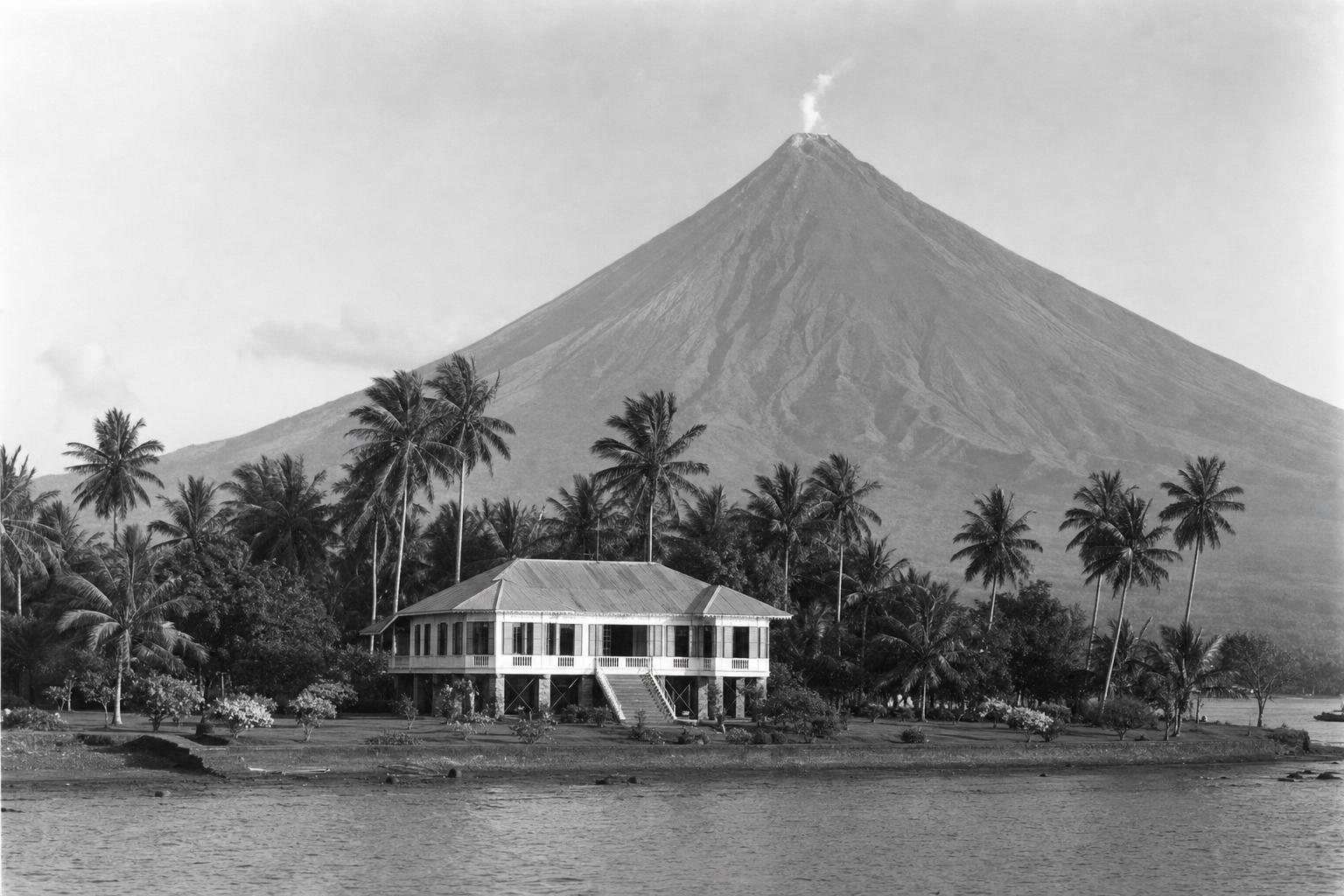
Two miniature purple velvet slippers hang in my china cabinet, little emblems of good luck given to me when we left the Philippine Isles after we had spent many happy and adventurous years there. I cannot pick them up without remembering that happy land and its' carefree hospitable people. We lived with them during years of peace and years of war when the Japanese overran the country and my husband and I and our two small sons left our home to hide on lonely islands seeking food and shelter. Here they lie, these little slippers in the palm of my hand, and whisper that it was only yesterday that we went to live in Legaspi, but though it is not so, how well I remember our arrival there! The dusty, untidy little town sprawled right down to the sea with houses on stilts built on the beaches and wharf. A cool breeze followed us in from the sea and clouds of pearly smoke swirled about the summit of Mt. Mayon whose slopes came gently down to the sea. Our little inter-island steamer anchored alongside the wharf where carabao carts and trucks waited for cargo.
Soon wiry little brown men were scurrying up the gang planks and then down again laden with sacks of flour. Naked little boys shrieked and called to each other as they dived off the wharf into the soupy looking water; fishermen returning with their fish called to their wives in the stilt houses as they passed up the wharf to the market to sell the catch. The wives exchanged gossip while they hung gay sleeping mats and embroidered pillows out in the sun to air, and swept the dust out of their little one-roomed Nipa houses. As I watch these chattering women and looked across the harbour at the little bancas skidding like insects along the surface of the water, the porters were busy unloading our baggage. When I thanked them for this they smiled and said "You're welcome, mam." After saying goodbye to the Captain we drove off the wharf and through the town to the big old house by the sea, which was to be our home. There smiling servants welcomed us. We soon found that when thanked for any small service they beamed and said, "You're welcome, Mam." Ren and I laughed at this little phrase at first but soon accepted it as a polite figure of speech. Everyone used it; servants, shopkeepers, office boys and the market women. We did not know that a time was coming when fleeing from the Japanese we would knock on the bamboo doors of Nipa huts far away in the hills and ask for shelter and hear the same words, "You're welcome Mam and Sir." Even though sheltering us might mean death or torture for them, they took us in and those words for me will always symbolise the courage and kindness shown by many strange Filipinos to four helpless, homeless, white strangers.
We settled down happily in the big house called San Rogue after the patron Saint of the barrio or village. The rooms were spacious with huge windows, the main living room was eighty-five feet long with a floor of alternating boards of yellow and black hard wood polished so much over the years that it glowed with life. The other rooms opened off this one, with the exception of the kitchen and servant quarters which were apart from the rest of the house, connected by a narrow verandah. Mt. Mayon framed all the windows at the back of the house, and from the front ones, was the magnificent spectacle of the wide bay stretching to the Gulf of Albay and bounded by the islands of Cagrary, Rapu Rapu and Batan. Outside our garden was the coconut fringed beach. It was impossible to have an orderly garden because every time there was a typhoon the sea swept up the beach into it and surrounded the house. Outside each window there were heavy iron shutters on hooks which were dropped and bolted down over the windows when a typhoon was coming, and so the wind and sea spray and the driving rain were kept out even though the old house rocked and groaned and seemed ready to collapse. The garden was a pleasant wilderness of pink periwinkles, sea grass, coconut palms and bright purple bougainvillaea.
Further along the beach from the house was San Rogue Barrio, a little collection of Nipa huts set amongst the palm trees beside a tidal river. Here the Filipino's who worked for my husband's firm lived with their families. A tiny Chapel always decorated with paper and tinsel flowers, was dedicated to San Rogue and a statue of him clothed in a brown monks habit, accompanied by his sheep dog, held pride of place to the right of the little altar. Nearby was a small one-roomed school. The village people were happy and prosperous and the Nipa huts and paths around them were swept and clean. At Christmas time the Barrio looked like fairyland. Outside each hut the family hung a lighted lantern, each one different; a star of Bethlehem, a rose, a ship, a gaily coloured fish or plane, made a softly lighted path from house to house. Ramon, our houseboy made a beautiful star for Paddy, our two year old son, for Christmas time in 1941, and in early December each night we lit the candle inside it and the soft light glowed on our shuttered verandah, a sign of Peace on Earth and Goodwill to all Men, though the windows were darkly curtained as an air raid precaution.
Behind the Barrio were the slopes of Mt. Mayon, rising to a perfect cone at 8,000 ft., patterned from the sea to the tip in shades of grey and green. Sea green first, then the silvery grey coconut palms topped with glossy dark green leaves. Further up the slopes the bright green of young paddy fields, then the pale green abaca and banana plantations took over, and finally the dense dark green of the forest with its' twining vines and tropical tree ferns stopped altogether where the grey lava from the crater from the crater had spilled over the mountain top and hardened into barren rock.
Life certainly was leisurely and peaceful in those idyllic days. Looking back I realise we had five house servants to look after three of us. Li Sai was our Chinese cook, Ramon and Auri were house boy and house girl. Ramon's only duties were to skate over the floors twice a day on coconut husks until they shone, and in the evening bring in the tray of drinks, dressed in a crisp white Camisa and white trousers. During the day he went to school. Mari, the baby Amah, was utterly devoted to her small charge, Paddy, Andrea, the lavendera, spent her days under the house washing and ironing our clothes, stopping regularly to squat in the shade and smoke a long black cigar.
Then of course there was Tereo, who drove the office car and always kept a long knife under the front seat on long journeys so that he could protect the master adequately if trouble should come; most unlikely in that peaceful province. Jose, the gardener completed the household.
When we first lived at San Rogue, we found we gave asylum to a quite harmless lunatic, who spent his days at the bottom of the kitchen steps waiting for hand outs from the cook, and his nights curled up like a dog under the house. Poor man, he looked so wild in his dirty torn clothes, with his matted hair hanging down around his shoulders, but he appeared quite happy gibbering and singing to himself all day. The barrio children called him "Loco Loco" or sometimes "Abra Lata". Fortunately he died in his sleep before war came. The Japanese are not kind to imbeciles. "Abra Lata" means "unopened can".
Our day began with breakfast at six fifteen, and by seven Ren left for his office in the town, or went to the Hemp & Copra bodegas or warehouse. He was manager locally for an English Company who exported hemp and copra and imported machinery, flour, cloth, office equipment and many other goods. Sometimes he drove to the various hemp/copra districts to visit the buyers who were usually Chinese though the hemp was grown by Filipinos. Quite a lot of the coconut plantations were owned by Spaniards. As soon as Ren had gone Li Sai would come to the dining room and discuss the day's menu, and collect the market money and the "Chow money" for the servants. The food always cost a little less than he said it did, but it was the custom for the cook to make a little on his purchases, and he would not have been the only one to lose face if I had ever suggested that he was overcharging me. A blind eye was useful quite often. He was an excellent cook and enjoyed guests just as much as I did, even the unexpected ones. Sometimes I would dash along to the kitchen and ask if he could manage five more people for dinner. He would grin and say cheerfully "can do Mam, You dlinkee and talkee maybe one hour then dinner all light." And it was always all right too. His food was a delight to look at, as well as to the palate. He liked to do the family shopping, buying beautiful Chinese silks for evening gowns for me, and bringing home a tailor friend with a selection of materials to measure Ren for a suit. He was a much better bargain hunter than I ever was whether the stores were Chinese, Filipino, or Spanish. He had a poor opinion of my bargaining powers. He was really devoted to Ren, and had attached himself to us when we had employed him as a temporary cook during our honeymoon in Baguio. He hadn't much time for me and soon let me know I was not welcome in my own kitchen. Any recipe I ever gave him to make was a horrible flop, but he looked at me so innocently and contritely, that I never could be really cross. He hated the sea and boats big or small, but spent long hours cleaning scraping and painting our 26ft Vixen, though he never could be persuaded to sail with us. He gambled and sometimes he lied to us, but he loved Ren and we found him lots of fun and quite indispensable the war he went back to Manila, and for months he took food parcels to the gates of Santo Tomas Internment Camp for us until at last he found that we were not there; actually we were hiding in the hills then and were not inmates of Santo Tomas for some time after.
When I was pregnant, Li Sai would bring me the most revolting concoctions of wild cat pickled in native gin which, he assured me earnestly, would make me strong and the mother of a son. I couldn't refuse him but carried the bowl into the bedroom and later flushed it down the toilet. Squid tentacles went the same way. He was delighted when our second son, Stephen, was born. So was I satisfied.
Though life was leisurely, it was not idle. When Ren came home at five in the evening we played tennis or swam in the warm sea and sometimes we sailed the little Vixen down the moonlit bay, or on dark nights settled amongst the fishermen anchored in their bancas fishing with a bright kerosene lamp suspended over the water to attract the fish. Some nights the sea was phosphorescent and lights dripped off my fingers and toes as I skimmed the surface with them. At week-ends we climbed part of the way up Mayon or stayed overnight at rest houses four thousand feet up. I never got to the top of the mountain but Ren did and actually climbed into the smoking crater. At four thousand feet up, there was a glorious panorama of the surrounding hills and towns and the sea far away below us.
Daytimes I spent playing with Paddy on the beach or in the garden, or swimming lazily while Mari and Paddy played together. I nearly always swam towards the bamboo piers owned by the various hemp and copra firms which were built out from their bodegas. Here there was always a ship being loaded with copra or hemp. I could see the cargadors coming through the bodega doors with loads of copra, if it was a copra ship, on their backs. Along the high narrow bamboo pier they trekked one after the other across the gang plank and tipped the copra into the hold and back again for more. If I nearly closed my eyes they looked like hundreds of little black ants hurrying determinedly about their business.
Ships of all nations came into Legaspi Port to load hemp and copra. The water was very deep near the piers, so ships coming in dropped anchor, backed to within ten feet of the pier, a plank was placed from pier to ship, ropes secured from ship to shore and loading started. Sometimes in a bad sea a large ship trying to anchor pushed the entire bamboo pier down like a pack of cards. Slap! Slap! Slap! While I lived in San Rogue more than one drunken sailor returning from a night at the Aqua Caliente Cabaret missed his footing on the narrow gang plank and was drowned.
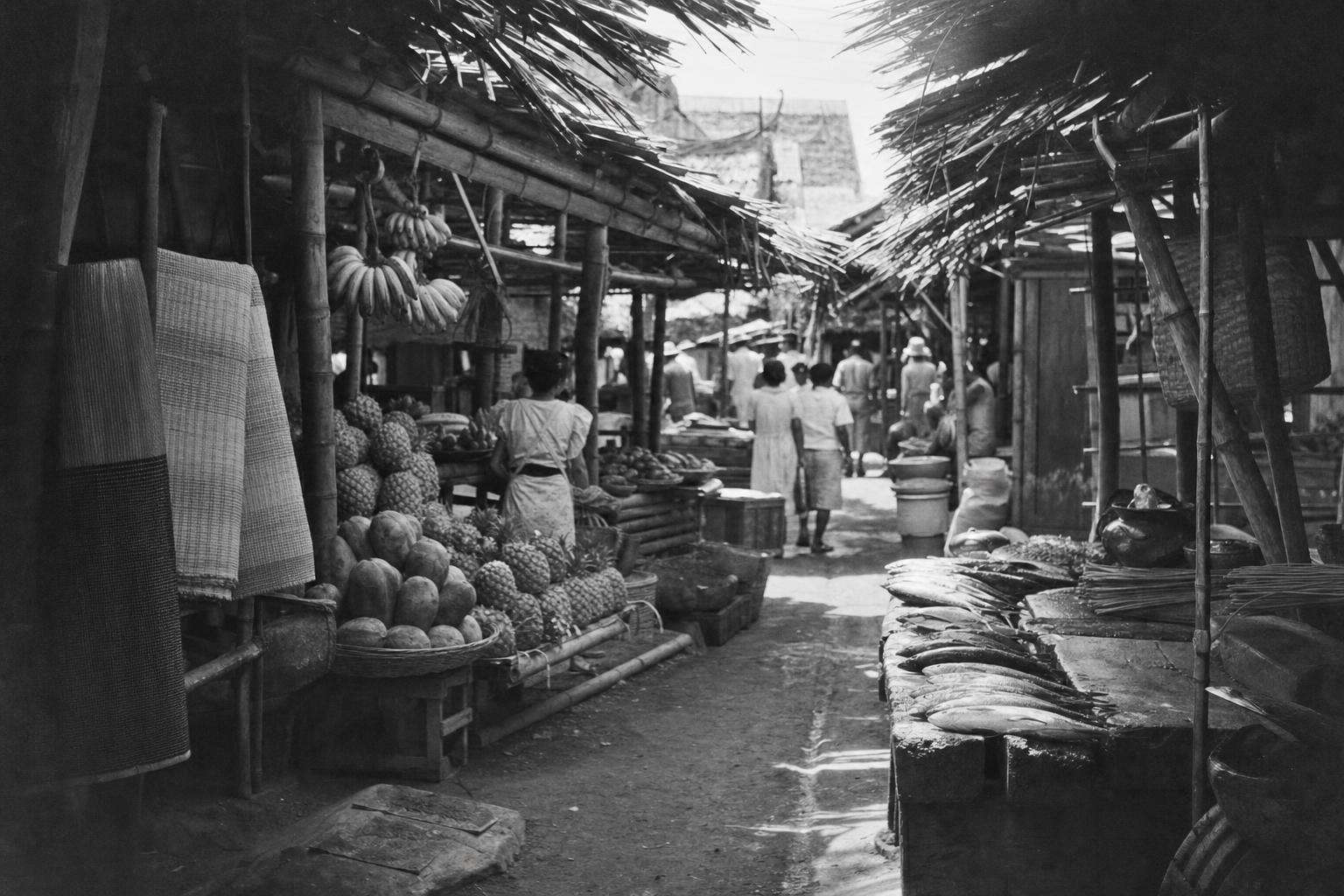
Other mornings I spent at the market, always the nerve centre of the town where its affairs are volubly discussed in the various Filipino dialects and Spanish, Chinese, and Chinese-English. The stalls were made of bamboo with a Nipa palm to keep out the rain and the sun. They were close together in rows with narrow dirt paths between. Chinese, Filipinos, Spaniards, Mestisos jostled and bargained with each other vigorously and noisily. The heat seemed more oppressive than it really was because compounded with it were the smells of garlic, sharp pineapple, hair oil, dried fish, raw meat, tuber roses and dried horse dung. Dominating all was a symphony of cackling hens, crying children, barking dogs and vituperative bargaining in a medley of tongues.
In the fish lane gleaming on wet stone slabs were huge sail fish, rompecondado, talikitok, and barracuda silvery blue and just fresh from the sea. Squid, rainbow fish, minute deelies and sprats formed a glittering moving sheet of colour on another slab, while claws tied, live crayfish, shrimps, pale pink, big and small, and freshly caught flat paluds which just taste like Dover Sole. Along the path stood kerosene cans full of tiny salted raw fish which the Filipinos relish on boiled rice. On some days there were slimy cucumbers, sea slugs and green and yellow seaweed for making gelatine all piled together shimmering on the grey stone. Always there were huge baskets of dried fish for cooking in coconut milk or dropping into vegetable soup before serving. A delightful if smelly place.
Splashes of bright colour indicated the fruit and vegetable stalls. Pyramids of golden sweet smelling pineapple and green and yellow papayas were displayed alongside pale yellow pomelos, and above them hung huge hands of pink Gloria bananas, green lacatans, and the curious long mottled green and black Sabang Castilla, and the stumpy yellow cooking bananas. Golden mangoes were heaped in baskets next to long green runner beans. Chinese cabbage, bright red tomatoes, sweet young corn and in season big red bell peppers and the tiny red and green varieties. There were always bundles of garlic tied up somewhere strong smelling when bruised.
If I wanted to buy presents I went to either the pottery stalls or the basket and mat stalls. The old lady at the pottery stall sold round red rice bowls, stew pots, ovens and stoves like plant pots with a hole cut in the side to put charcoal inside with a grid on top; there were flat red clay cake pans, huge water jars, plant pots, garden urns and orchid pots. At fiesta time Paddy loved to come with me and inspect the garishly coloured cocks, cats, dogs and holy statues, and the miniature sets of cooking utensils were his special joy as he could fit a set into the palm of his small hand. Choosing something to take home always involved a lot of discussion and inspection of almost all the coloured array.
Purple, green, red, yellow and blue petates or sleeping mats hung on the wall. They were pliant and most intricately woven into them in different colours were maps of the islands or the words "Welcome" and "Come back again". Here in a corner of the mat and basket vendors stall were rolls of plaid mats of every known and unknown clan hemp slippers or velvet beaded ones, and all to be had for a few cents in those far away days.
As I wandered from stall to stall I only had to pause a second before the woman at the counter would call out "Buy this Senora, Buy". Or the man at the broom stall would ask if my little boy needed kite string today or didn't the house girl need new coconut husks to polish the floor, and he would give Paddy pretty little bags of bamboo leaves that he made while Paddy watched him with wide-eyed interest.
Before I went home I always looked around the rice and corn section. I could smell the grain and feel the ground rice powder irritating my nose. There were many types of rice in sacks, some open so the purchaser could inspect the grain for length and smell it for freshness. There was sticky new rice for making bibinka cakes and Shuman, pink mountain rice sometimes called oloroso. The corn didn't seem so interesting to me; it could be bought whole or ground. The vendor had a ganta measure for measuring the grain. It wasn't very long before I could tell whether his stock was fresh or not.
Paddy liked to go to the Poultry and sugar stalls. At the latter he always came away with a lump of raw sugar with pili nuts embedded in it, or puffed rice dipped in christalised sugar. At the poultry section we passed down a line of hens and ducks all very much alive and securely trussed lying on the dusty ground. The owners sat on their haunches in the shade smoking and chatting waiting for customers quite undisturbed by the noise or the discomfort of their produce. They were scrawny birds and one wouldn't make a decent meal for two people.